I. Introduction: The Real Cost of Mis-selection in Industrial Processes
In industrial automation, choosing the wrong process instrument is never just a minor paperwork error—it is an expensive ticking time bomb. Whether you are managing a chemical reaction loop, a municipal water treatment facility, or an oil and gas transfer terminal, selecting an improper flow or level instrument can lead to catastrophic batch failures, inaccurate custody transfer billing, or unplanned plant shutdowns that bleed thousands of dollars every hour.
For many plant engineers and procurement specialists, wading through dense product catalogs often feels like navigating a minefield. Choosing an overly complex or unverified model causes budget overruns and operational friction. Conversely, opting for a cheap, unverified alternative leads to erratic readings under pressure, chemical corrosion, and control loop instability.
Drawing from years of frontline industrial sourcing, global technical supply, and hands-on field debugging, this guide strips away the dry, repetitive technical jargon. Instead, we approach Endress+Hauser’s (E+H) industry-leading ecosystem from a practical, field-proven perspective, offering a complete Endress Hauser flow meter selection guide to optimize your procurement and engineering workflow.
II. Endress+Hauser Ecosystem Overview: Where Precision Meets Reliability
2.1 Introduction to E+H's Global Standing in Process Automation
Endress+Hauser is a leading global brand in industrial measurement instrumentation, specializing in flow, level, pressure, temperature, and analytical technologies for decades. Backed by Swiss engineering standards and continuous innovation, the company delivers high-market-share solutions for chemical, oil and gas, food and beverage, and water and wastewater industries.
The product portfolio spans five core measurement pillars alongside industrial data management services. Certified to international standards including CE, UL, and IECEx, E+H maintains a service network across domestic industrial hubs and over 160 countries globally, helping plant operators optimize economic efficiency while ensuring stringent safety and environmental compliance.
2.2 How Matching Fluid Dynamics, Temperature, and Pressure Ratings Prevents Premature Component Failure
Fluid Dynamics Matching: Selecting the Correct Measurement Principle
Matching instrument technology to specific fluid properties—such as viscosity, density, solids content, and corrosiveness—serves as the primary defense against premature failure.
Coriolis Mass Flowmeters: Unaffected by fluid physical properties, these meters accurately measure liquids and gases including oils, lubricants, fuels, liquefied gas, solvents, and compressed air. The Endress+Hauser Promass F series handles demanding process conditions with fluid temperatures up to +350°C, pressures up to 100 bar, and mass flow rates up to 2200 t/h. For high-pressure and corrosive oil and gas applications, the Endress+Hauser Promass 83O/84O withstands pressures up to 258 bar and measures highly corrosive media like hydrogen sulfide ($H_2S$).
Radar Level Transmitters: Designed for powders, bulk solids, and liquids. The Endress+Hauser Micropilot M FMR244 operates at approximately 26 GHz for non-contact measurement in abrasive solids (such as ferrite and glass) with a range up to 15 meters.
Guided Wave Radar: Models like the Endress+Hauser Levelflex M FMP40 suit dusty environments for solid and liquid interfaces, handling vacuum pressures down to 40 bar and ranges up to 35 meters.
Hydrostatic Pressure: The Endress+Hauser Waterpilot FMX165 utilizes a ceramic flush-mounted capacitive diaphragm probe for hydrostatic level measurement up to a 200-meter water column.
Temperature Rating Matching: Avoiding Thermal Stress Failures
Exceeding rated temperature limits triggers sensor drift, seal degradation, and electronic component failure.
Standard Ranges: Standard instruments like the Endress+Hauser Micropilot M FMR244 operate between -40°C and 130°C, while the Endress+Hauser Levelflex M FMP40 covers -40°C to 150°C.
High-Temperature Applications: The Endress+Hauser Promass F series accommodates fluid temperatures up to +350°C, and the Endress+Hauser Cerabar S PMP635 (with diaphragm seal) spans -40°C to +350°C.
Cryogenic & Extreme Conditions: The Endress+Hauser Proservo NMS5 operates from -200°C to 200°C for custody transfer level, interface, and density measurement, while the Endress+Hauser Prothermo NMT539 provides cryogenic options down to -170°C.
Radiometric Measurement: The non-contact Endress+Hauser Gammapilot M FMG60 functions across arbitrary temperature and pressure boundaries for extreme process conditions.
Pressure Rating Matching: Safeguarding Structural Integrity
Exceeding maximum allowable working pressure leads to diaphragm deformation, gasket leaks, or housing rupture.
High-Pressure Applications: The Endress+Hauser Promass 83O/84O is engineered for offshore and onshore high-pressure service up to 258.6 bar (3750 psi).
Medium-High Pressure: The Endress+Hauser Promass F operates up to 100 bar, and the Endress+Hauser PMP51 pressure transmitter covers 1 to 400 bar with an overpressure limit of 600 bar.
Differential & Static Pressure: The Endress+Hauser Deltabar S FMD630 differential pressure transmitter features a 160 bar overpressure limit and 0.10% reference accuracy, while the Endress+Hauser Cerabar S PMP635 offers a 600 bar overpressure limit with a 20:1 recommended turndown ratio.
Low Pressure & Vacuum: The Endress+Hauser Levelflex M FMP40 supports vacuum up to 40 bar, and the Endress+Hauser Micropilot M FMR244 supports vacuum up to 3 bar.
Material Compatibility: Combating Corrosion and Wear
Wetted parts selection dictates service life in aggressive or erosive chemical environments.
Corrosion Resistance: The Endress+Hauser Promass 83O/84O handles corrosive sulfur compounds, and the Endress+Hauser Cerabar S PMP635 provides wetted material options including Hastelloy C, 316L, titanium, and PTFE foil.
Abrasion Resistance: The wetted components of the Endress+Hauser Micropilot M FMR244 utilize PVDF, PTFE, PP, and PBT to withstand abrasive solid streams.
Sanitary Compliance: The Endress+Hauser Promass F series supports CIP/SIP clean-in-place sterilization for food, beverage, and life sciences.
Communication and System Integration: Ensuring Long-Term Stability
Modern automation frameworks require seamless DCS, PLC, and SCADA connectivity via protocols like HART, PROFIBUS PA/DP, Modbus, and EtherNet/IP. For instance, the Endress+Hauser Proservo NMS5 integrates via 4-20mA HART, Modbus, V1, WM550, BPM, Mark-Space, and relay contact outputs, while the Endress+Hauser Gammapilot M FMG60 supports 4-20mA HART, FOUNDATION Fieldbus, and PROFIBUS PA.
Summary: Key Parameters for Failure Prevention
Matching Dimension | Core Consideration | Potential Failure Consequence |
Fluid Dynamics | Viscosity, density, solids content, corrosiveness | Measurement distortion, sensor plugging, or erosion |
Temperature Rating | Process temperature within instrument limits | Sensor calibration drift, seal aging, electronic failure |
Pressure Rating | Maximum overpressure below structural limits | Diaphragm deformation, seal leakage, housing burst |
Material Compatibility | Wetted parts vs. chemical properties | Corrosive perforation, accelerated mechanical wear |
Communication Protocols | Control system hardware and network compatibility | Data loss, communication dropouts, integration failure |
III. Flow Measurement: Matching Technology to Fluid Physics
1. Electromagnetic Flowmeters (e.g., Promag 500 Series)
Application: Conductive Liquids, Slurries, and Chemicals
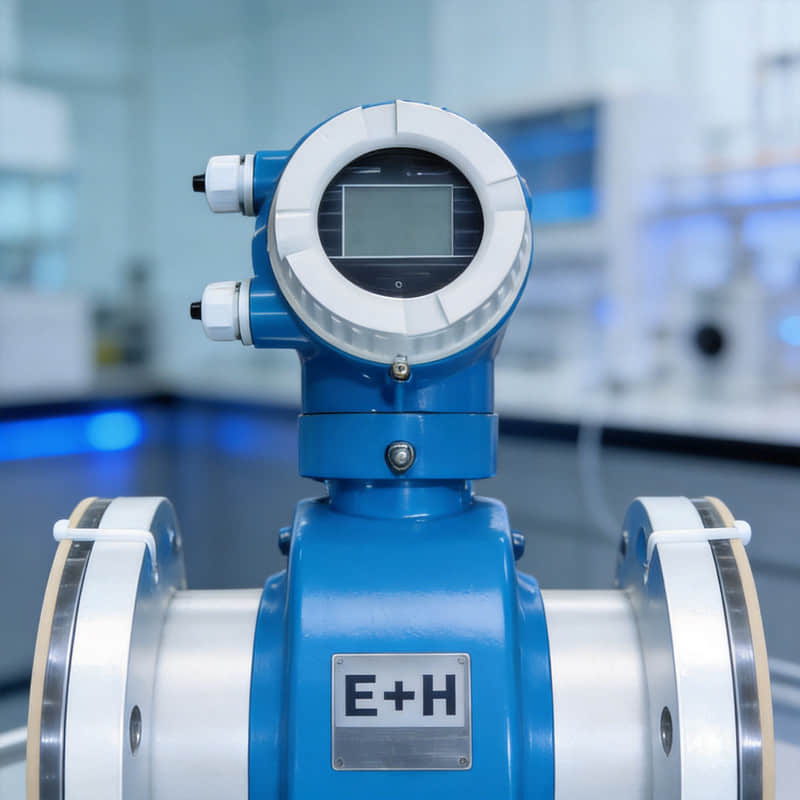
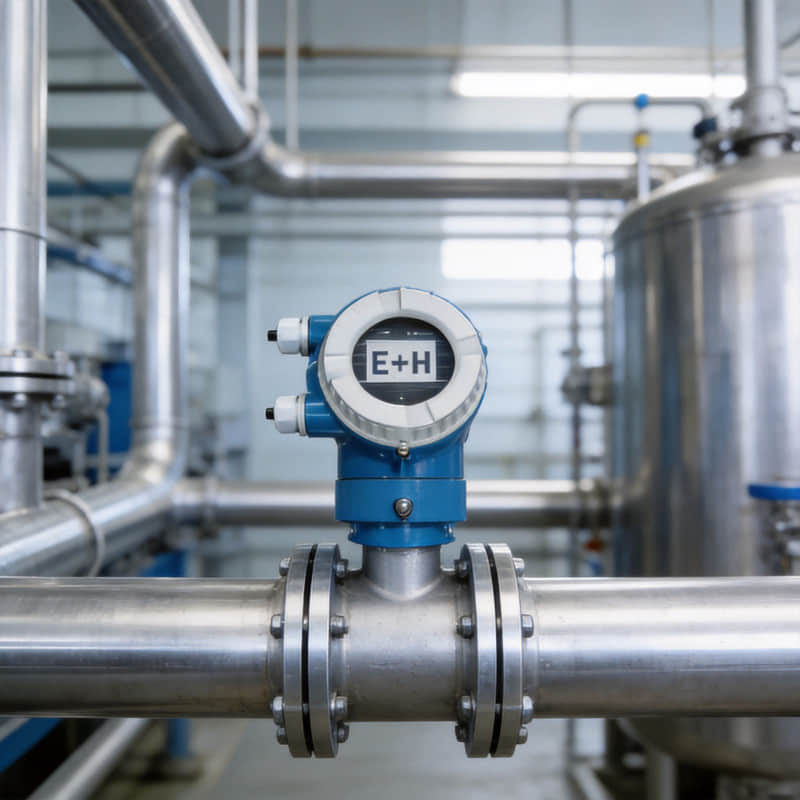
Core Principle: Electromagnetic flowmeters operate on Faraday's law of electromagnetic induction, requiring a minimum fluid conductivity (typically 5cm. This makes them ideal for water, wastewater, acid-base solutions, and chemical slurries. The Endress+Hauser Proline Promag W800 represents a benchmark for municipal water networks—featuring battery power, EN ISO 12944 corrosion protection, and smart power-saving modes for remote deployment. When evaluating options, understanding how to choose E+H electromagnetic flow meter solutions ensures long-term operational stability in severe industrial water loops.
Field Insight: The Promag series dominates water and chemical dosing loops through the deep integration of sensor design and digital signal processing. Endress+Hauser flowmeters utilize advanced sensor geometries, proprietary digital signal processing, and Heartbeat Technology to deliver high accuracy, wide turndown ratios (up to 1000:1), and long-term zero stability. For chemical dosing lines handling frequent batch transitions and aggressive reagents, the fully welded sensor construction eliminates leakage risks and lowers maintenance overhead.
2. Coriolis Mass Flowmeters (e.g., Proline Promass 80/83 Series)
Application: Direct Mass Flow, Density, and Temperature Measurement
Core Principle: Coriolis mass flowmeters measure mass flow independently of fluid physical properties like viscosity and density, simultaneously capturing mass, density, and temperature. The Endress+Hauser Promass F series (including 80F/83F/84F/F100/F200) serves demanding process conditions with fluid temperatures up to 350\C, process pressures up to 100bar, and mass flow rates up to 2200t/h. When assessing device lineups, reviewing a detailed Promass vs Promag flow meter comparison helps clarify whether a Coriolis or magnetic solution fits your exact custody transfer needs.
Field Insight: In custody transfer, Coriolis meters provide multi-variable tracking without external temperature or pressure compensation. The balanced dual-tube design resists external pipe stress, eliminating the need for upstream or downstream straight pipe runs. For high-value fluids like refined fuels, liquefied gas, and solvents, optional PremiumCal calibration ensures strict fiscal metering compliance. Furthermore, the Promass 83O/84O is engineered for extreme oil and gas service, withstanding pressures up to 258bar and measuring corrosive hydrogen sulfide safely under international hazardous area certifications.
3. Thermal Mass Flowmeters (e.g., Endress+Hauser 65I 30Ba)
Application: Gas Flow Measurement Without Pressure Drop Penalties
Core Principle: Thermal mass flowmeters rely on thermal dispersion to determine mass flow, offering direct gas mass measurement without temperature or pressure compensation. With no moving parts or flow obstructions, they introduce virtually zero pressure drop—a critical advantage for compressed air, natural gas, and flue gas monitoring.
Field Insight: Thermal flow meters optimize gas utility monitoring through three operational advantages:
Zero Pressure Drop: Unlike traditional differential pressure devices (such as orifice plates), insertion thermal meters leave the flow path unconstricted, reducing compressor energy waste.
Wide Turndown & Low Velocity Sensitivity: Turndown ratios exceeding 100:1 capture low-end consumption leaks and high-flow surges accurately.
Direct Mass Output: Eliminating external pressure and temperature transmitters simplifies loop architecture.
Selection Quick Reference
Measurement Principle | Target Media | Core Advantages | Typical Application | Representative Models |
Electromagnetic | Conductive liquids, slurries | Zero pressure drop, corrosion resistant, wide turndown | Water treatment, chemical dosing | Promag 500 series, Proline Promag W800 |
Coriolis | Liquids, gases (independent of physical properties) | Direct mass/density/temperature, high precision | Custody transfer, multi-parameter tracking | Proline Promass 80/83 series, Promass 83O/84O |
Thermal | Gases | Zero pressure drop, no compensation required | Compressed air, natural gas monitoring | Endress+Hauser 65I 30Ba |
Selection Decision Factors
Fluid Physics Verification: Conductivity dictates electromagnetic suitability; fluid independence favors Coriolis; gas-only constraints point to thermal technologies. Evaluate viscosity, solids content, and chemical compatibility first.
Accuracy versus Capital Cost: Coriolis meters provide top-tier fiscal accuracy pm 0.1% at a higher capital cost, electromagnetic meters balance performance and price pm 0.5%, and thermal meters optimize utility gas monitoring pm 1--2%
Installation Constraints: Ensure full-pipe conditions for magnetics, evaluate straight-pipe exemptions for Coriolis, and confirm adequate upstream clearance for thermal insertion probes alongside field bus protocols (HART, PROFIBUS, Modbus). Systematic alignment of fluid properties with measurement principles ensures long-term operational stability. Utilizing tools like the Endress+Hauser Applicator software helps engineers verify sizing parameters prior to procurement.
IV. Level Measurement: From Liquids to Aggressive Solids
1. Radar Level Transmitters (e.g., Micropilot FMR51 / FMR57 Series)
Application: Non-Contact Measurement for Harsh Chemicals, High Temperatures, and Bulk Silos
Core Principle: Radar level transmitters operate on non-contact microwave reflection principles, calculating distance independently of fluid density, conductivity, or viscosity. This technology overcomes severe dust, steam, foam, and temperature stratification. The Endress+Hauser Micropilot series scales from basic utilities to extreme process demands:
Micropilot FMR51: Engineered for high-temperature and high-pressure oil, gas, and chemical applications. It features K-band (~26 GHz) frequency, pm 2\ mm accuracy, operating temperatures from -196\C to 450\C, vacuum to 160\ bar pressure ratings, and wetted parts in 316L, Alloy C, PTFE, or ceramic. It carries SIL 2 safety certification (IEC 61508) and HistoROM data storage for multi-echo tracking reliability.
Micropilot FMR57: Tailored for solid bulk inventory in tall silos, coal bunkers, or open yards. Its narrow parabolic antenna beam angle eliminates false echoes caused by dust, loading noise, and thermal gradients.
Micropilot FMR250: Designed for continuous non-contact level tracking of powders and granules (such as cement, raw meal, or animal feed) up to 200\C, featuring an integrated air purge connection for heavy dust environments and two-wire loop power with HART, PROFIBUS PA, and FOUNDATION Fieldbus protocols.
Field Insight: When configuring bulk storage systems, referencing an official Endress Hauser Micropilot FMR50 datasheet provides critical insights into beam emission angles, antenna selections, and echo evaluation capabilities. In complex tanks featuring internal agitators, heating coils, or narrow geometries, antenna beam width dictates signal integrity. Narrow beam angles concentrate microwave energy onto the target surface, bypassing internal structural obstacles. Combined with multi-echo tracking algorithms, E+H radar transmitters isolate true product levels amidst stirrer blades or condensing vapors.
2. Vibrating Level Switches & Point Level Detection
Application: High/Low-Level Alarm and Overflow Protection for Powders and Liquids
Core Principle: Vibrating switches utilize a piezoelectric drive to oscillate a tuning fork at its resonant frequency. Contact with media shifts the frequency and amplitude, generating a switch output independent of dielectric constant, dust buildup, or foam.
Liquid Limit Detection (Liquiphant Series): The Endress+Hauser Liquiphant FTL20 and FTL31 provide compact point level detection in pipes and vessels up to 150\C, serving as reliable alternatives to floats or capacitive sensors for overfill and pump dry-run protection.
Solid & Bulk Detection (Soliphant & FTL51H Series): The Soliphant FTM21 and FTM50 handle fine or coarse solids, offering plug-and-play setup without calibration. The Liquiphant FTL51H features corrosion-resistant fork coatings for dense powders, slurries, and viscous chemicals, supporting PROFIBUS PA and health self-monitoring.
Field Insight:
Media Density Matching: Match tuning fork sensitivity to material density. Low-density lightweight powders (e.g., PVC paste resin at 0.02 g/cm³) require specialized low-density variants to prevent missed triggers.
Temperature & Pressure Limits: High-temperature processes (such as thermal dryers) demand specialized variants rated up to 400\C, surpassing standard 150\C to 280\C thresholds.
Insertion Length & Maintenance: Select appropriate probe lengths (up to 6 meters for deep silos) while leveraging maintenance-free vibrating designs to reduce upkeep.
Selection Quick Reference
Measurement Technology | Target Media | Core Advantages | Typical Application | Representative Models |
Radar Level Transmitters | Liquids, slurries, bulk solids | Non-contact, unaffected by fluid properties, dust/steam immunity | High-temp/high-pressure chemical, tall storage silos | Micropilot FMR51, FMR57, FMR250 |
Vibrating Liquid Switches | Liquids | Immune to conductivity/buildup/foam, maintenance-free | Overfill protection, pump dry-run protection | Liquiphant FTL20, FTL31 |
Vibrating Solid Switches | Powders, granular solids | Unaffected by dust accumulation, high temperature tolerance | Silo high/low level alarm, plugged-chute detection | Soliphant FTM21, FTM50, Liquiphant FTL51H |
Selection Decision Factors
Media State & Contact Nature: Choose non-contact radar for corrosive liquids, suspended solids, or high silos; deploy vibrating switches for point-level overfill alarms and pump protection.
Environmental Extremes: Verify that enclosure ratings (such as IP68 submersible housings) and temperature parameters match the process envelope.
System Integration & Safety: Ensure functional safety compliance (SIL 2/3) and hazardous area approvals (ATEX, IECEx) align with plant specifications.
V. Pressure & Analytical Instrumentation
1. Pressure Transmitters (e.g., Cerabar Series)
Application: Absolute and Gauge Pressure Monitoring for Stable Loop Control
Core Principle: Pressure transmitters serve as foundational devices for ensuring process stability and safety. The Endress+Hauser Cerabar series utilizes advanced ceramic or metal capacitive sensors to deliver high measurement accuracy and long-term stability, while incorporating Heartbeat Technology for self-diagnostics and predictive maintenance.
Field Insight:
High Precision & Stability: Featuring metal thin-film or ceramic sensors, the Cerabar S PMP635 (with diaphragm seal) operates up to +350\C, handles overpressure limits up to 600\ bar, and provides a 20:1 recommended turndown ratio.
Smart Diagnostics: Heartbeat Technology provides online self-checking and predictive fault diagnosis, preventing unplanned shutdowns in advanced plant architectures.
Corrosion Resistance: Wetted parts include Hastelloy C, 316L, titanium, and PTFE foil, tailored for severe chemical, petrochemical, and offshore applications
Sanitary Design: Flush-mount diaphragm configurations comply with EHEDG and 3-A standards for life sciences and food and beverage, eliminating impulse line clogging.
Explosive Atmosphere Approvals: Global certifications (ATEX, IECEx) combine with HART, PROFIBUS PA, and FOUNDATION Fieldbus protocols for seamless DCS integration.
2. Analytical Sensors: Digital pH Electrodes (e.g., Memosens Technology) and Conductivity Meters
Application: Water Treatment and Quality Assurance
Core Principle: Online analytical instrumentation dictates compliance, product quality, and process efficiency in water and chemical treatment loops. Endress+Hauser addresses traditional sensor vulnerabilities through digital Memosens technology
Field Insight
Electromagnetic Immunity & Long-Distance Transmission: Traditional high-impedance analog pH signals degrade in humid environments. Memosens converts measurements to digital signals internally and transmits them via inductive contactless coupling over distances exceeding 100 meters without specialized cables.
Plug & Play Offline Calibration: Integrated microchips store calibration data and sensor health history, allowing technicians to calibrate sensors in a lab environment before field installation
Fouling & Aging Resistance: Specialized glass formulations and open-junction references extend sensor life in aggressive wastewater streams, while contactless connectors prevent galvanic corrosion.
Regulatory Compliance: Memosens tracks audit trails and calibration data to support FDA 21 CFR Part 11 requirements in pharmaceutical processing.
Comprehensive Conductivity Ranges: Inductive (toroidal) sensors handle aggressive, high-conductivity chemical solutions, whereas contact sensors monitor ultra-pure water loops.
VI. A 4-Step Field Decision Roadmap
Step 1: Process Parameter Audit (Media Compatibility, Operating Temperature, and Pressure Limits)
Core Logic: Process First, Medium Foremost
The initial step in instrument selection bypasses product catalogs in favor of compiling a comprehensive operating profile—detailing fluid characteristics (corrosivity, solids content, high viscosity, and electrical conductivity), process conditions (temperature, pressure, and environmental ingress protection), and installation constraints (indoor/outdoor, hazardous areas, and vibration levels). This baseline dictates selection validity, directly governing operational lifespan as well as facility safety, fire protection, and compliance.
Media Compatibility Evaluation Points:
Electrical Conductivity: Electromagnetic flowmeters mandate fluid conductivity of ge 5 \cm; non-conductive media (such as pure oils and industrial gases) require Coriolis or thermal mass solutions
Corrosivity: Acid-base chemical services prioritize 316L stainless steel, Hastelloy, or PTFE-lined variants; food and pharmaceutical applications demand hygienic instruments meeting 3A and FDA certifications
Solids and Viscosity: High-viscosity slurries pair with wide-bore, anti-clogging electromagnetic flowmeter configurations to ensure long-term uncompromised performance
Adhesiveness: Powder silos require anti-buildup radar level transmitters, while sticky slurries necessitate non-stick wetted geometries.
Temperature and Pressure Rating Matching:
Match instrument temperature ratings to process thermal limits to prevent sensor calibration drift, seal aging, and electronic component damage
Select pressure classes according to maximum overpressure thresholds to avoid diaphragm deformation, gasket leaks, or housing rupture.
Turndown Design Guidelines: Size level transmitter ranges at 1.2 times maximum operational level; configure flowmeter ranges at $1.3\times$ maximum operational flow to eliminate over-range damage or low-end resolution loss.
Operational Criticality Grading: Assign instrumentation functionality based on process importance: indicator types for monitoring non-critical variables; trend recorders for secondary parameters; control loops for primary variables; totalizers for material accounting and utility consumption; and alarm interlocks for safety-critical parameters.
Step 2: Hazardous Area Certifications (ATEX, IECEx, FM Requirements for Explosive Environments)
Core Logic: Safety Compliance, Certification First
Within explosive atmospheres containing hazardous gases or dusts (common in oil, gas, and chemical facilities), instrumentation must hold valid explosion-proof certifications. Endress+Hauser portfolios support international standards including ATEX, FM, CSA, TIIS, IECEx, and NEPSI; selection must match local regulatory mandates for the target installation site
Key Certification Standards Comparison:
ATEX: Mandatory European compliance framework for EU member states and aligned markets.
IECEx: International Electrotechnical Commission scheme offering broad global harmonization for multinational projects
FM/CSA: North American certifications governing installations across the United States and Canada.
NEPSI: Chinese explosion protection approval for regional domestic plants.
Selection Execution Points:
Determine hazardous area zone classifications (Zone 0/1/2 or Division 1/2) to select appropriate protection concepts (intrinsic safety, flameproof, increased safety)
Verify enclosure ingress protection ratings: outdoor deployments require $\ge \text{IP67}$ protection, supplemented by shielding modules in high-interference environments.
Severe operating envelopes (extreme temperature, high pressure, heavy dust loads, high vibration, or deep vacuum) dictate custom-engineered sensor structures and specialized materials. For instance, specialized high-temperature radar deployments in defense materials powder silos achieve continuous, stable tracking at 180\C with pm 0.5% accuracy.
Step 3: System Integration (HART, Profibus, FOUNDATION Fieldbus Compatibility with DCS)
Core Logic: Seamless Interoperability, Data Synchronization
Modern process automation frameworks require instruments to integrate smoothly with distributed control systems (DCS), programmable logic controllers (PLCs), and supervisory control and acquisition (SCADA) platforms. Endress+Hauser devices support broad industrial bus protocols including HART, PROFIBUS PA/DP, Modbus, and EtherNet/IP, requiring precise compatibility verification during design
Communication Protocol Selection Guide:
HART: Ubiquitous point-to-point protocol with robust backwards compatibility, well-suited for brownfield retrofits.
PROFIBUS PA/DP: Tailored for mainstream automation architectures like Siemens control platforms, enabling digital messaging and remote diagnostics.
FOUNDATION Fieldbus: Built for multi-variable control loops and peer-to-peer device communication in complex facilities.
Modbus / EtherNet/IP: Optimized for PLC and SCADA network integration with minimal configuration overhead.
Digitalization and Remote Lifecycle Management: Industrial IoT advancements yield remote oversight, predictive maintenance, enhanced interoperability, and cybersecurity frameworks. Specifications should favor smart-communication, IoT-ready assets to lower lifetime overhead and retain upgrade pathways. Endress+Hauser’s Heartbeat Technology provides self-diagnostics that continuously monitor health parameters alongside accurate primary variables, serving facilities pursuing asset optimization and digital management. Rugged industrial designs minimize unplanned downtime risks
Step 4: Sourcing & Traceability Security (Avoiding Counterfeit, Gray-Market, or Uncalibrated
Units—Emphasizing Strict AS6081 Compliance and Official Channel Traceability
Core Logic: Authentic Assurance, Controlled Traceability
Industrial supply chains face risks from counterfeit and unauthorized gray-market instrumentation. Non-compliant sourcing introduces measurement drift, material discrepancies, and safety failures. Procurement pipelines must enforce rigorous traceability protocols
AS6081 Compliance Framework: AS6081 establishes rigorous criteria for detecting and avoiding fraudulent electronic components within aerospace sectors; its core principles apply equally to industrial instrumentation procurement—demanding traceable quality management systems that verify authorized channels and comprehensive compliance records for every component.
Authentication Traceability Points
Factory Authorization: Prioritize vendors holding formal manufacturer authorizations and verify distribution credentials
Chain of Custody: Require complete supply chain documentation, including serial numbers, certificates of origin, and customs clearance declarations
Calibration Documentation: Ensure every instrument ships with verifiable calibration records linked to national or international metrology standards
Reliability Evidence: Review operational historical logs, factory stress-testing standards (thermal cycling, pressure impulse testing, long-term burn-in), and safety certifications.
Total Cost of Ownership (TCO) Evaluation: Evaluations must incorporate initial acquisition, installation, projected maintenance schedules, spare parts availability, and technical support response metrics. Localized technical support and readily available inventory minimize downtime and hidden operational expenses. Selecting pre-calibrated, quick-disconnect designs reduces outages; specifying maintenance-free units with an MTBF exceeding 50,000 hours—such as non-contact radar level devices free of mechanical wear components—further drives down operational costs.
Summary: Framework Implementation Matrix
Step | Core Focus | Key Execution Actions | Potential Failure Consequence |
Step 1: Parameter Audit | Media, temperature, pressure | Compile parameter audit list, match range and wetted materials | Measurement distortion, hardware destruction |
Step 2: Hazardous Certifications | ATEX, IECEx, FM | Verify explosive classification zones, match protection concepts | Safety hazards, regulatory non-compliance |
Step 3: System Integration | Communication protocols, DCS compatibility | Validate protocol handshakes, enable remote diagnostic support | Data loss, network integration failure |
Step 4: Traceability Security | AS6081, authorized channels | Audit distribution credentials, verify calibration certificates | Counterfeit risk, production out |
VII. Conclusion & Expert Sourcing Support
Selecting the right process instrumentation is a strategic investment in plant safety, operational uptime, and long-term cost control. As we’ve explored, whether you are deploying electromagnetic flowmeters for aggressive chemical dosing or radar level transmitters for high-temperature storage silos, a structured selection process eliminates operational risks and prevents costly downtime.
However, matching the exact model code, measuring range, wetted materials, and hazardous area approvals can be complex. That is where professional guidance makes all the difference.
Explore More Formats & Join the Discussion:
If you prefer to review this information in alternative formats or want to connect with our engineering community, you can access our resources across multiple platforms:
SlideShare: View and download the structured presentation summary on our Endress+Hauser Flow & Level Instrument Selection Guide
Scribd: Read and share the complete technical document on our Field-Proven Selection Guide: Endress+Hauser Flow & Level Instruments
LinkedIn: Join the technical conversation, share your industrial automation experiences, and follow our updates on Endress+Hauser Process Instrumentation Selection & Sourcing Guide