
Previous
Next
Tyco 711P Optical Smoke Detector Guide
1. Introduction to Tyco Fire Detection Technology
Tyco Safety Systems: Architecture and Application
In the commercial and industrial life safety sector, Tyco has long been an industry benchmark for system stability. Its fire detection architecture is engineered to provide early warning and deliver long-term, stable performance in complex environments where fault tolerance is minimal.
From large-scale industrial manufacturing plants to high-traffic commercial complexes, Tyco's hardware—ranging from control panels to field devices—integrates seamlessly with existing infrastructure. This provides facility management and safety operations personnel with a clear, real-time grasp of site status, ensuring efficient deployment across complex spaces and under rigorous fire safety codes.
Core Solutions: Precision Detection Technology
The success or failure of fire management often hinges on the performance of field-level detection equipment.
Modern tyco smoke detector solutions have long evolved beyond simple signal triggering, developing into high-precision instruments capable of accurately distinguishing true fire signatures from routine environmental interference.
The industry is rapidly pivoting toward advanced tyco multi detectors. These devices utilize dual-path sensing technology to drastically cut false alarm rates at the root—with false alarms historically serving as a primary headache for plant maintenance teams.
By pairing high-sensitivity optical smoke chambers with intelligent signal processing algorithms, these devices trigger alarms during the initial stages of combustion, satisfying the rigorous industrial demand for fast, reliable responses.
This guide combines our company's 15 years of on-site engineering and installation experience to examine key selection factors for the updated Tyco 711P series, helping professionals navigate decision-making with fewer missteps and optimized outcomes.
2. Featured Product Deep-Dive: Tyco 711P Optical Smoke Detector
Product Overview
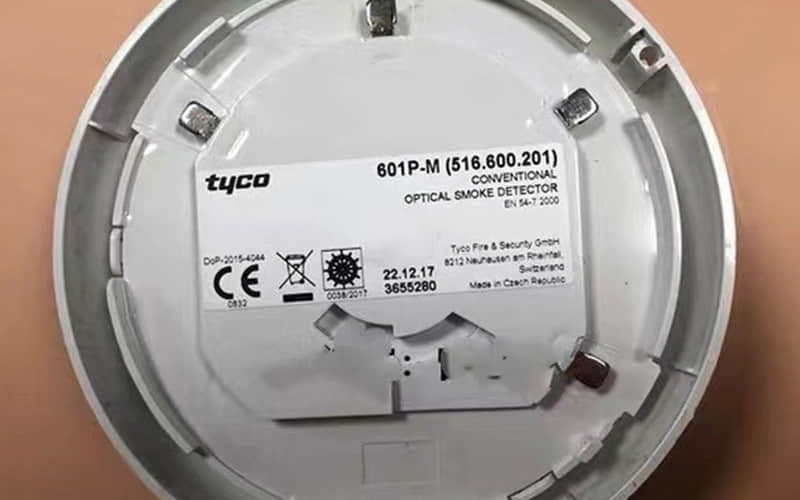
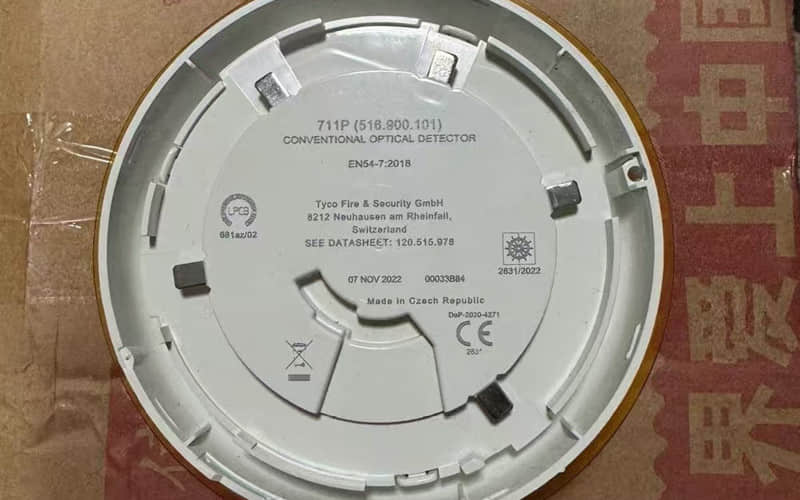
The Tyco 711P is an advanced, microprocessor-controlled photoelectric smoke detection device engineered specifically as the direct, modernized successor to the legacy 601P-M model for early fire warning across industrial and commercial environments.
This detector utilizes enhanced optical sensing technology to efficiently identify visible smoke particles generated by smoldering or slow-burning materials, such as overheated PVC insulation and foam plastics.
Technical Specifications & Core Parameters
l Part Number: 516.900.101 (Tyco 711P Optical Smoke Detector)
l Operating Voltage Range: 10.5–33 VDC (Loop powered)
l Standby (Static) Current: Approx. 50 µA
l Alarm Current: Max. 50 mA (Configured via control panel)
l Enclosure Material & Color: FR 110 Bayblend flame-retardant material, white
l Product Net Weight: Approx. 90 grams
l Operating Temperature Range: -20°C to +70°C
l Storage Temperature Range: -25°C to +80°C
l Relative Humidity Tolerance: Up to 95% (non-condensing)
Sensing Mechanics & Sensitivity Profile
The detector features an optimized optical measuring chamber paired with sophisticated digital signal processing technology.
Its operational principle functions as follows: smoke particles entering the sampling chamber scatter infrared light pulses; the scattered light hits a photodiode and converts into an electrical signal; the internal microprocessor then compares this signal against dynamic ambient thresholds to trigger an alert.
This design prevents minor insects entering the chamber from causing false alarms while offering high sensitivity toward smoldering fires, such as upholstered furniture, foam plastics, and overheated PVC in electrical service areas.
Core Performance Features
Automatic Drift Compensation: Features advanced microprocessor-controlled calibration that automatically compensates for dust and dirt accumulation within the optical chamber over time, maintaining consistent sensitivity and extending operational lifespan.
Strong EMI/RFI Immunity: Built using FR 110 Bayblend flame-retardant material, offering robust resistance against electromagnetic and radio frequency interference to guarantee stable operation in electrically complex environments.
Industrial Applications & Selection Recommendations
The Tyco 711P (Part No. 516.900.101) is ideally suited for high-risk industrial and commercial scenarios:
l Oil and gas exploration, production, storage, and Floating Production Storage and Offloading (FPSO) vessels
l Offshore drilling platforms and onshore refinery facilities
l Chemical processing and warehousing, painting and powder coating workshops
l Marine environments requiring strict compliance standards (supported by major marine type approvals)
During actual selection, factors such as fire characteristics, ceiling height, and environmental temperature and humidity must be comprehensively evaluated. The 711P serves as the standard drop-in replacement for older 601P systems, retaining full backward compatibility with standard 4-inch, 5-inch bases and isolator bases to satisfy the networking demands of comprehensive fire safety systems.
3. Series Comparison & Cross-Reference: Integration with Manual Call Points and Specialized Sensors
I. System Integration of 711P with Manual Call Points
In fire alarm system design, pairing the Tyco 711P optical smoke detector with manual call points is a key step toward achieving complete zonal coverage. According to system design standards, the Tyco MCP CP200 indoor manual call point (Part No. 514.001.042) serves as the standard companion device. This non-waterproof call point is suited for indoor dry environments, meeting alarm requirements across most commercial and industrial spaces when paired with the 711P.
For outdoor or humid environments requiring waterproofing, system designs should incorporate the Tyco MCP230 waterproof manual call point (Part No. 514.001.010). Additionally, the Tyco MCP220Ex explosion-proof manual call point (Part No. 514.001.109) applies to hazardous zones containing explosive gases. This tiered configuration strategy ensures comprehensive coverage from general office spaces to high-risk industrial sites.
II. Technical Comparison with Ionization Smoke Detectors
The Tyco 711P utilizes photoelectric smoke detection technology, with its core advantage lying in responsive detection of smoldering fires. It effectively detects visible smoke produced by slow-burning or smoldering materials (such as interior furnishings and foam plastics), as well as smoke from overheated yet unignited PVC. Its advanced signal processing and drift compensation technology prevent false alarms triggered by tiny environmental particles.
By contrast, Tyco's ionization smoke detector series (such as the Tyco MF301 ionization smoke detector, Part No. 516.020.002) is more sensitive to ultra-fine particles generated by fast-flaming fires. In system layout, these two technologies often complement each other: photoelectric detectors suit general areas and electrical service rooms prone to cable overheating, whereas ionization detectors suit locations requiring rapid response to open flames.
III. Multi-Sensor Adaptability Assessment
Tyco provides a complete sensor solution ecosystem for challenging industrial environments:
Explosion-Proof Series: Specialized explosion-proof variants suit high-risk environments such as oil and gas exploration, production, and storage facilities, alongside petrochemical processing, storage, and transport plants. Additionally, the Tyco MR301EX explosion-proof smoke detector (Part No. 516.021.003) and Tyco MD301EX explosion-proof heat detector (Part No. 516.023.002) provide alternative explosion-proof choices.
Flame Detection: For locations requiring rapid response to open flames, the Tyco 601F-M flame detector (Part No. 516.600.007) and Tyco 811F flame detector (Part No. 516.800.007) serve as vital supplements, suiting areas prone to liquid pool fires without an initial smoldering phase.
Heat Detection: The Tyco 601H-R-M heat detector (Part No. 516.600.203) and Tyco 631H-F (Part No. 516.600.033) offer reliable monitoring for temperature-sensitive zones.
Multi-Sensor Combination: For complex environments requiring simultaneous monitoring of smoke and temperature fluctuations, multi-sensor combinations—such as pairing the 711P with a heat detector—achieve comprehensive fire threat forecasting.
4. Practical Installation, Maintenance, and Replacement Guidelines
I. Base Installation and Wiring Steps
Installing the Tyco 711P optical smoke detector (Part No. 516.900.101) requires a compatible mounting base. Weighing approximately 90 grams and constructed from FR 110 Bayblend flame-retardant material, the detector operates across -20°C to +70°C, stores between -25°C and +80°C, and tolerates relative humidity up to 95% (non-condensing).
Compatible Base Selection
l 4-inch detector base (Part No. 517.050.041)
l 5-inch detector base (Part No. 517.050.017)
l Isolator 4-inch base (Part No. 517.050.043)
l Isolator 5-inch base (Part No. 517.050.018)
l MUB M600/900 base (Part No. 517.050.401)
l Continuity 4-inch base (Part No. 517.050.042)
l Diode continuity check 4-inch base (Part No. 517.050.045)
l Deck mounting box 4-inch (Part No. 517.050.051)
l Deck mounting box 5-inch (Part No. 517.050.603)
Installation Steps
Power-Off Verification: Confirm the system is powered off, noting an operating voltage range of 10.5–33 VDC.
Base Mounting: Secure the base firmly onto the ceiling or wall, verifying a flat mounting surface.
Wiring Connections: Wire according to system schematics, noting a static current of ~50 µA and alarm current of max 50 mA.
Twist-Lock Insertion: Twist and lock the detector head into the base until the mechanical latch clicks into position.
Power-On Testing: Conduct functional tests after energizing the loop.
II. Maintenance and Testing Protocols
Routine Testing Methods
Testing with standard aerosol test gas effectively verifies detector functionality. Direct the test gas toward the smoke entry ports and verify that the detector triggers an alarm at the preset threshold. The unit's modern chamber design and built-in filtering prevent false alarms from small environmental particles.
Optical Chamber Cleaning Recommendations
l Periodically check smoke inlet ports to ensure they remain clear of dust and debris.
l Gently clean the exterior of the optical chamber using a clean soft-bristled brush or compressed air.
l Avoid applying liquid cleaners directly to internal components.
l Clean or replace the unit promptly if response times noticeably lengthen or persistent drift warnings occur.
Maintenance Frequency Guidelines
Depending on the operating environment, functional tests are recommended every 6 to 12 months. Shorten maintenance intervals in heavy dust or high-contamination industrial settings.
III. Replacement and Spare Parts Procurement Guide
Product Lifecycle Update Information
Note that the Tyco 711P (Part No. 516.900.101) is the current standard production model, fully replacing legacy units such as the older 601P-M in all new installations and system expansions.
Compatible Alternative Solutions
l Tyco 711P Optical Smoke Detector (Part No. 516.900.101): Standard baseline choice for modern addressable loops.
l Tyco 601F-M Flame Detector (Part No. 516.600.007): Suited for spaces requiring fast open-flame response.
l Tyco 601H-R-M Heat Detector (Part No. 516.600.203): Suited for temperature-sensitive environments.
l Tyco 631H-F Heat Detector (Part No. 516.600.033): Provides supplemental thermal monitoring capabilities.
Procurement Recommendations
To protect system compliance and reliability, source original, imported Tyco products through authorized channels. Verify credentials during purchasing:
Verify Product Authenticity: Request customs declaration documents and source verification paperwork to ensure genuine imports.
Confirm Product Condition: Confirm parts are brand-new original stock rather than refurbished or secondhand goods.
Procure Matched Bases: Purchase matching detector bases concurrently according to site mounting requirements.
Direct Upgrade Choice: Select the 711P series directly for replacement projects to benefit from its built-in drift compensation and microprocessed reliability.
5. Summary and Related Products
System Ecosystem Integration
Successful deployment of life safety infrastructure relies on more than standalone device performance; it demands absolute compatibility across the entire signaling loop.
Whether utilizing the Tyco 711P optical smoke detector or the MCP CP200 manual call point, units interface smoothly with modern addressable fire alarm control panels (FACPs).
By maintaining strict communication protocols and stable loop current draws, these devices guarantee precise panel diagnostics, zone mapping, and event logs, providing safety operators with comprehensive operational awareness during routine checks or emergency response.
Procurement and Supply Chain Support
Contact our supply chain team directly to confirm real-time stock availability for immediate dispatch and secure global logistics arrangements.
For more, please refer to: Tyco 601P-M Optical Smoke Detector
Back to the top: Taco