1. Introduction to Endress+Hauser Instrumentation in Industrial Automation
Series | Type | Target Industry | Key Advantage |
Promag P 300 | Electromagnetic | Chemical & Heavy | High temp (220°C), corrosion resistant |
Promag H 300 | Sanitary Flow | Food & Pharma | PFA lining, CIP/SIP, 3-A/EHEDG certified |
Cerabar PMP71B | Pressure | Chemical & High-Press | Up to 700 bar, 0.025%accuracy |
Cerabar PMP11 | Pressure | OEM & General | Cost-effective, compact baseline |
Why E+H Remains the Gold Standard in Process Control
In modern industrial automation, process reliability dictates operational profitability. Industrial automation measurement instruments wholesale and procurement sectors rely heavily on Endress+Hauser (E+H) for its superior measurement accuracy, long-term sensor stability, and robust diagnostics in aggressive plant environments. For process engineers and operators managing chemical refineries, wastewater treatment, or pharmaceutical lines, deploying E+H instrumentation minimizes unplanned downtime and ensures compliance with international safety and quality standards.
Core Ecosystem: Bridging Precision Flow, Pressure, and Level
The strength of the E+H portfolio lies in its holistic ecosystem. Rather than offering isolated devices, E+H provides an interconnected suite of instruments designed for plant-wide network communication:
Flow Measurement: Electromagnetic (Promag) and Coriolis (Promass) series ensure precise volumetric and mass flow tracking.
Pressure Measurement: Cerabar pressure transmitters deliver accurate gauge, absolute, and differential data under extreme profiles.
Level & Analysis: Complementary vibronic, radar, and ultrasonic level switches—alongside high-precision Memosens liquid analysis electrodes—complete total loop visibility.
2. Endress+Hauser Promag Series (Electromagnetic Flowmeters)
Working Principle & Heartbeat Technology Integration
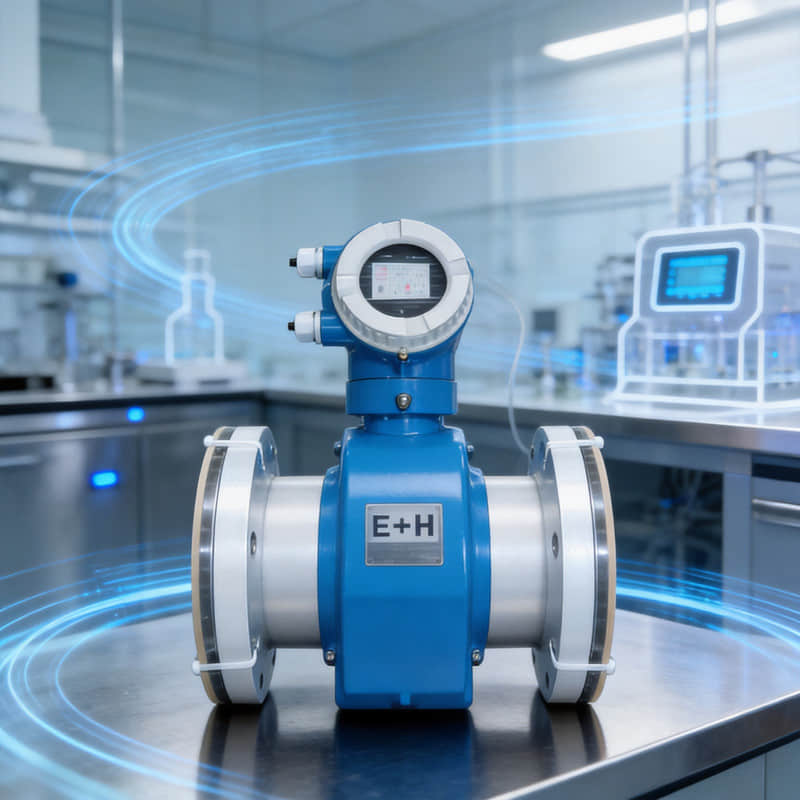
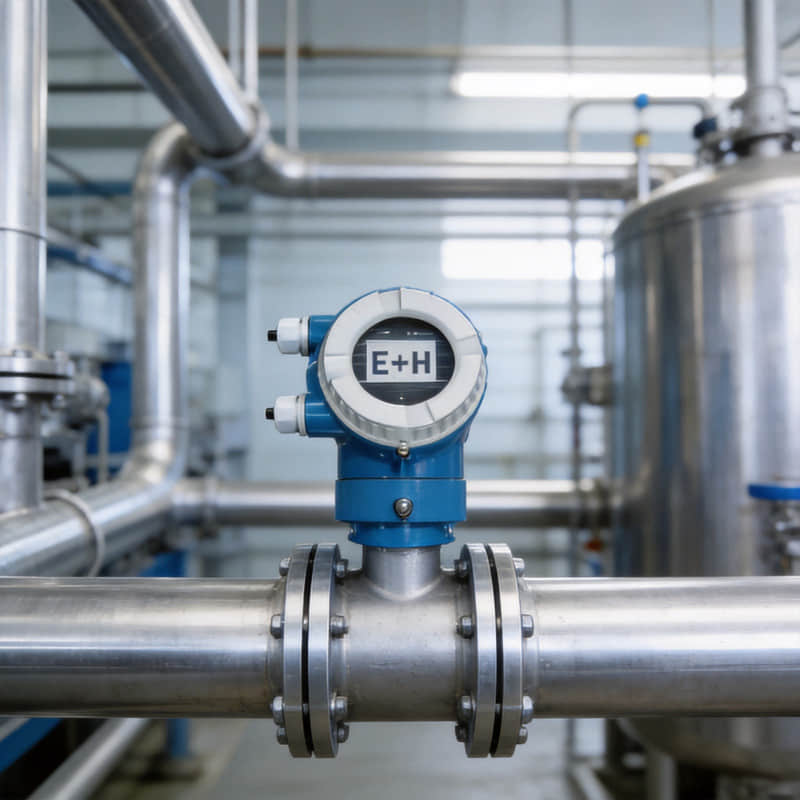
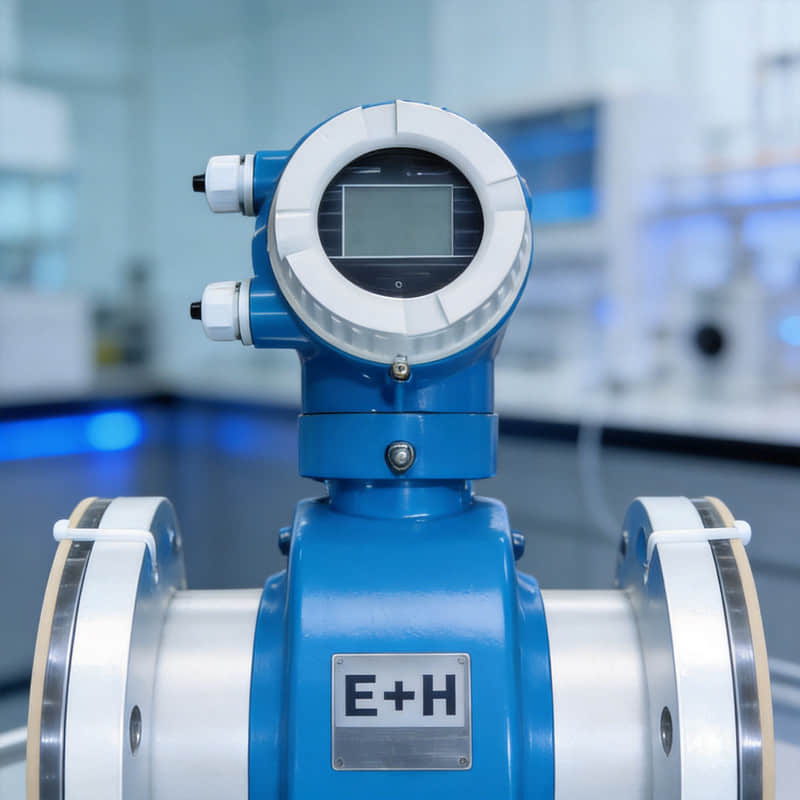
Consulting any standard Endress+Hauser Promag electromagnetic flowmeter manual reveals that the Promag series operates on Faraday's law of electromagnetic induction, requiring a minimum fluid conductivity of 5 $\mu$S/cm. Powered by a 16-bit microprocessor with full digital signal processing, it ensures high noise immunity and rapid calculation speeds.
Heartbeat Technology enables online self-calibration and process verification without interrupting operations, boosting plant availability and safety. It continuously monitors for electrode fouling and liner wear, reducing maintenance costs by up to 30% while securing compliance in regulated pharmaceutical and food sectors.
Core Series Breakdown and Industry Applications
Promag P 300 (Chemical & Heavy Industry): Engineered for corrosive liquids and high temperatures. Features an unobstructed pipe interior for zero pressure loss. The unique flow-process linked compensation algorithm maintains $\pm 0.1\%$ accuracy across extreme thermal swings (-50°C to 220°C). Covered by ATEX and IECEx dual explosion-proof certifications for pH 0–14 environments.
Promag H 300 (Hygiene & Life Sciences): Tailored for food, beverage, and sanitary processes. Features PFA linings, stainless steel housings, 3-A and EHEDG certifications, and an IP69 rating capable of enduring rigorous Clean-in-Place (CIP) and Sterilize-in-Place (SIP) cycles across DN 2 to 150.
Promag 10D & Economic Variants (Water & Wastewater): Wafer-style installation designed for tight piping layouts. Holds global drinking water approvals (ACS, KTW/W270, NSF 61, WRAS BS 6920) and supports bidirectional measurement independent of fluid density or viscosity.
Comparative Technical Guide: Promag P 300 vs Promag H 300
When evaluating a specialized Promag P 300 vs Promag H 300 technical guide, engineers must weigh chemical resistance against hygienic compliance:
Promag P 300: Built for heavy chemical processing, offering rugged flange connections, high-temperature tolerance up to 180°C, and diverse wetted options like Hastelloy and Tantalum.
Promag H 300: Optimized for cleanrooms and sterile utilities, utilizing PFA liners and flush process connections tailored strictly for CIP/SIP protocols in life sciences.
Q: What is the main difference between Promag P 300 and Promag H 300?
A: Promag P 300 is engineered for heavy chemical processing with high thermal and chemical resistance, whereas Promag H 300 is tailored for hygienic life science applications with flush PFA linings and CIP/SIP compatibility.
3. Endress+Hauser Cerabar Series (Pressure Transmitters)
Core Sensing Technologies
Ceramic Capacitive Sensors (PMC Series): Features 99.9% $\text{Al}_2\text{O}_3$ ceramic diaphragms offering high wear and overpressure resistance. Ideal for vacuum, corrosive, and abrasive slurry applications.
Metallic Diaphragm Sensors (PMP Series): Utilizes 316L stainless steel or Hastelloy. Excels in high-pressure operations (up to 700 bar) and extreme high temperatures (up to 400°C).
Flagship and Economic Series Breakdown
PMP71B & PMP51 (High-Performance Flagships): The PMP71B handles pressures up to 700 bar and temperatures to 400°C with $\pm 0.025\%$ FS accuracy and integrated Heartbeat Technology. The PMP51 supports up to 400 bar and meets SIL2 safety loop requirements (IEC 61508).
PMP21 & PMP11 (Compact & Economic): Entry-level transmitters built with capacitive ceramic diaphragms, delivering 0.5% reference accuracy and 0.2% URL/year long-term stability for standard industrial automation loops. A direct comparison of Cerabar PMP21 vs PMP11 price and specs shows that while the PMP11 serves as an economical OEM choice for basic gauge pressure, the PMP21 offers upgraded configuration flexibility and broader environmental ratings.
PMP55 (Flush-Mounted Sanitary): Features a flush diaphragm to eliminate clogging in viscous, crystallizing media, complying with EHEDG and 3-A guidelines for hygienic applications.
Diaphragm Materials & Chemical Compatibility
316L Stainless Steel: Standard utility water and neutral media; unsuited for strong acids/bases.
Alloy C276 (Hastelloy): Exceptional resistance against chlorides, sulfuric acid, and hydrochloric acid.
Tantalum: Resists hydrochloric acid and chlorine water; vulnerable to hydrofluoric acid and strong alkalis.
Ceramic (99.9% $\text{Al}_2\text{O}_3$): Superior abrasion resistance and high overpressure tolerance for solids-laden flows.
4. Practical Selection Matrix: Promag & Cerabar Cross-Industry Matching
Comprehensive E+H Pressure and Flow Meter Selection Guide
Utilizing a structured E+H pressure and flow meter selection guide ensures optimal deployment across diverse industrial plants:
Industry Application | Recommended Flow Series (Promag) | Recommended Pressure Series (Cerabar) | Key Environmental Challenges |
Chemical Industry | Promag P 300 / Promag 400 | Cerabar PMP71B / Cerabar PMC71 | Highly corrosive media, high temp/pressure, explosion-proof requirements |
Water Treatment | Promag 10D / Promag W 400 | Cerabar PMP21 / Cerabar PMP11 | Large pipe sizing, potable water certifications, humid conditions |
Food & Beverage | Promag H 300 | Cerabar PMP55 / Cerabar PMP51 | CIP/SIP compatibility, hygienic certifications, high-viscosity media |
OEM Machine Building | Promag 10D / Economic Variants | Cerabar PMP11 / Cerabar PMP21 | Compact footprint, cost control, volume supply capacity |
Practical Case Study: Selection Pitfall Guide for Corrosive Fluid Lines
Scenario: A fine chemical plant handling 120°C high-temperature textile wastewater containing mixed acids, bases, dyes, and fiber residues.
Pitfalls Overcome:
Lining: Replaced standard rubber with PTFE to withstand thermal stress up to 120°C.
Electrodes: Replaced 316L with Hastelloy C (HC) to prevent chloride attack.
Ingress Protection: Implemented a split-version design (separating converter from sensor body) to counter extreme ambient humidity.
Final Solution: Promag P 300 (PTFE + HC electrodes) paired with a high-temp Cerabar PMP71B (metallic diaphragm).
5. How to Read E+H Order Codes
Order Code Structure: Using Cerabar PMP5B as an Example
To master Endress+Hauser Cerabar PMP5B specifications, buyers must understand that E+H emp
loys a modular coding system where each position represents a specific technical parameter:
Example Structure: PMP5B-NFBACBF...
Model: PMP5B (Cerabar high-performance pressure transmitter)
1st Position (N): Explosion protection (e.g., ATEX II 1/2G Ex ia IIC T6)
2nd Position (F): Sensor measuring range (e.g., 0–100 bar)
3rd Position (B): Process connection (e.g., DN25 flange)
4th Position (A): Diaphragm material (e.g., 316L stainless steel)
5th Position (C): Fluid fill (e.g., silicone oil)
6th Position (B): Electronic module / output signal (e.g., 4–20 mA HART)
7th Position (F): Housing material / protection rating (e.g., Aluminum IP66/67)
Common Selection Pitfalls to Avoid
Sensor Approvals: Always verify exact zone ratings (Zone 0/1/2) and temperature classes (T1–T6) rather than relying on a generic "explosion-proof" label.
Output Signals: Match protocol architecture (4–20 mA HART, PROFIBUS PA, FOUNDATION Fieldbus, Modbus RS485, EtherNet/IP) with the existing DCS/PLC network.
Calibration Certificates: Specify compliance tiers (Factory, ISO 17025, or Heartbeat validation) early to prevent audit failures in regulated industries.
6. Conclusion & Expert Procurement Advice
Summary: The Ultimate ROI of Precision Engineering
Deploying Endress+Hauser Promag flowmeters and Cerabar pressure transmitters demands meticulous attention to specifications. Aligning exact parameters with your site conditions is the ultimate safeguard against costly downtime and premature component failure.
Call to Action (CTA): Streamline Your Sourcing
Navigating complex order codes shouldn't slow your project. Send your RFQ parameters—including temperature, pressure limits, and flange sizes—to receive instant technical cross-referencing and a competitive export quote today.
Explore More Formats & Join the Discussion:
If you prefer to review this information in alternative formats or want to connect with our engineering community, you can access our resources across multiple platforms:
SlideShare: View and download the structured presentation summary on our E+H Promag & Cerabar Technical & Selection Guide
Scribd: Read and share the complete technical document on our Endress+Hauser Promag & Cerabar Sourcing and Technical Whitepaper
LinkedIn: Join the technical conversation, share your industrial automation experiences, and follow our updates on E+H Promag & Cerabar Technical & Selection Guide for Industrial Automation
Related Technical Guides & Resources
Looking for expert advice beyond our product catalog? Explore our in-depth technical articles for selection, operation, and troubleshooting:
Related Products: