1. Introduction
The STT250 and ST3000 series belong to an earlier generation of Honeywell transmitter products. Specifically, the ST3000 smart pressure transmitter traces back to the first smart pressure transmitter launched by Honeywell in 1983, while the STT250 is a mid-tier model in the STT3000 smart temperature transmitter product line, which, together with the STT350 and STT150, forms a three-tier temperature measurement portfolio. These products have long service lives and large installed bases in industrial sites. However, as legacy platforms, their spare parts supply, technical support, and long-term stability risks are continuously accumulating, making this the right window to systematically review replacement strategies.
It must be emphasized that obsolescence replacement is not simply about "buying a new model and installing it." A qualified upgrade must answer three core questions simultaneously:
l Can the unit be switched out under non-shutdown or short-shutdown conditions?
l Does the total lifecycle maintenance cost genuinely decrease?
l Are the new devices compatible with existing control systems, communication protocols, and safety interlocks?
If any aspect is under-considered, a replacement can turn from "cost-reduction" into "risk-increment." Especially on the temperature transmitter side, STT250 involves multiple sensor inputs such as RTDs and thermocouples, as well as multiple communication options like 4-20mA, HART, and DE. The cost of selection mismatch often exposes itself only after commissioning.
From the product evolution perspective, the SmartLine series is Honeywell's current mainstream upgrade path. SmartLine temperature transmitters (such as the STT750) offer single universal RTD inputs, digital accuracy up to 0.14\%, transmitter and sensor diagnostics, HART 7 communication, SIL 2/3 compliance, and up to a 3-year warranty; the pressure side continues the composite sensor technology and full-range accuracy advantages of the ST3000 through models like STG/STD. Compared to legacy platforms, the enhancements in diagnostic capabilities, digital communication, and safety certifications in SmartLine are the core values that replacement projects should deliver.
Subsequent sections of this guide will cover obsolescence impact assessment, replacement model mapping, communication and system compatibility verification, migration implementation steps, and risk control, helping engineering and maintenance teams turn "retrofit" into a verifiable, rollback-ready, and auditable upgrade.
2. Obsolescence Risks and Upgrade Value
Three Real-World Problems Caused by Legacy Product Obsolescence
l Hard-to-find spare parts with uncontrollable sources: STT250 and ST3000 have exited mainstream supply systems, and spot inventory in the market mainly comes from third-party distributor clearance stocks. For example, some distributors still list spot inventory lists for Honeywell ST3000 series differential pressure, pressure, single/dual flange, and temperature transmitters, while also listing Honeywell STT250 temperature transmitters, Honeywell STT171/STT173 temperature transmitters, and Honeywell SFC smart handheld communicators. The essence of such inventory is "stock clearance." Whether models, ranges, and communication options match the original site configuration completely depends on luck. Once a critical transmitter fails and inventory happens to be out of stock, the plant may be forced to reduce load or wait in shutdown.
l Unpredictable lead times: Obsolete models lack original factory production schedules, and lead times depend on secondary market and inventory turnover, ranging from "same-day shipping" to "months out of stock." For continuously running process units, uncertainties in spare parts lead times translate directly into unplanned shutdown risks, which is precisely what maintenance departments find hardest to explain to management.
l Complex parameter verification with high mismatch costs: Legacy platform model codes are lengthy and rule-complex, with great variations in combinations of communication protocols, sensor inputs, and certification options within the same series. Taking STT250 as an example, just in terms of communication and functions, it is divided into multiple variants such as STT25H (HART), STT25S (HART 6 plus TÜV SIL2 certification), STT25M (4-20mA, configurable via SFC, SCT, or MCT), STT25D (DE communication, digital integration into TDC3000/TPS/Experion PKS), and STT25T (dual sensor ports for sensor cross-checking or redundancy). If only the range is checked during replacement while ignoring communication protocols and system access methods, at best it cannot be configured, and at worst it breaks the digital integration link with the DCS. Furthermore, although the single-board electronic parts of the ST3000 series are interchangeable between Series 100 and Series 900, this "partial interchangeability" tends to make people underestimate the systemic workload of full-unit replacement
Value of Upgrading to SmartLine
l Improved accuracy and long-term stability: SmartLine temperature transmitters (such as the STT750) provide universal inputs, digital accuracy up to $0.14\%$, and transmitter and sensor diagnostic capabilities. The pressure side STG/STD continues the composite sensor technology and full-range accuracy advantages of the ST3000. Compared to legacy platforms, this means smaller measurement uncertainty and lower drift correction frequencies.
l More complete digital communication capabilities: SmartLine supports modern protocols like HART 7, whereas among legacy platforms only specific models like STT25D possessed DE digital integration capabilities. After upgrading, transmitters integrate more naturally into modern DCS architectures, and reading configuration, diagnostics, and asset management data no longer depends on dedicated handheld communicators or outdated interfaces.
l Enhanced self-diagnostics and safety certifications: SmartLine temperature transmitters comply with SIL 2/3 requirements and offer up to a 3-year warranty. Transmitter- and sensor-level diagnostics can provide early warnings before faults evolve into shutdown events. This creates a fundamental difference from the "fix-it-after-it-breaks" maintenance model of the STT250 era.
Actual Value for Plant Operation
Converting these capabilities into operational metrics yields benefits in three areas:
1. Pre-emptive diagnostics and spare parts standardization reduce unplanned shutdowns: Especially in applications like temperature measurement points that are numerous, distributed, and have high single-point failure impact.
2. Reduced maintenance frequency: Higher stability means fewer calibration and replacement man-hours, and SIL certification and long warranties reduce compliance audit proof costs.
3. Smoother integration with modern DCS: HART 7 and comprehensive diagnostic data transform transmitters from "dumb devices" into nodes continuously monitored by asset management systems, laying the data foundation for predictive maintenance.
4. Engineering Reminder: Whether upgrade value can be realized depends on whether communication protocols, system access methods, and safety certifications are verified item by item before replacement. The complexity of legacy platform model codes is a threshold in itself; it is recommended to make "whether the new device can be recognized and configured by the existing DCS" a hard acceptance criterion during the selection stage rather than fixing it after commissioning.
3. Core Replacement Cross-Reference List: Obsolete → Replacement
All replacement items listed below have been evaluated and verified by Honeywell China engineers to ensure 100% compatibility in installation dimensions, electrical performance, and system integration.
Honeywell Transmitter Obsolete & Replacement Cross-Reference List
No. | Honeywell Obsolete | Replacement Item | Remarks |
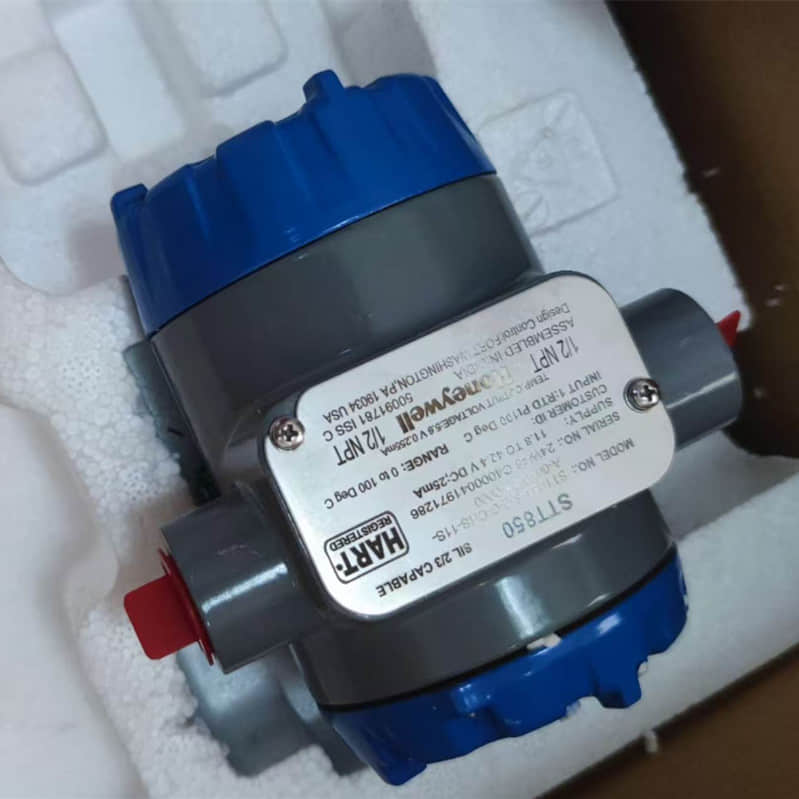
1 | STT35F-0-EPFM-FCTG-0010000-0D0-0000-3H | STT850-S-0-G-CHS-11S-A-00A0-F1-0000 | Temperature Transmitter, Single Input, Explosion-proof, with LCD Display, Calibration Report. |
2 | STG78L-E1G000-1-C-BHB-11C-B-00A0-FG | STG78S-E1G000-1-G-AHS-11S-A-00A0-00-0000 | Pressure Transmitter with Adapter. |
3 | STG77L-E1G000-1-A-AHB-11C-B-00A0-F1-0000 | STG77S-E1G000-1-A-AHS-11C-B-00A0-F1-0000 | SmartLine Pressure Transmitter, Drop-in Replacement. |
4 | STT25H-0-ENS-TTE-M10-2DC-00-3D | STT850-S-0-G-CHS-11S-A-00A0-F1-0000 | Temperature Transmitter, Upgrade to SmartLine STT850. |
5 | STT850S0CBF16CB+ | STT850-S-0-G-CHS-11S-A-00A0-F1-0000 | Standard Configuration Replacement for STT850 Series. |
6 | STG77L-F1G000-1-C-BHC-11C-B-20A0-FG, FX+ | STG77S-E1G000-1-C-BHS-11C-B-20A0-FG, FX-0000 | Pressure Transmitter, High Range Option. |
7 | STG79L-E1G000-1-C-BHS-11C-B-00A0-F1-0000 | STG79S-E1G000-1-G-AHS-11S-A-00A0-F1-0000 | Pressure Transmitter, Direct Replacement. |
8 | YSTR93D-11A-1A0JLGJBCDNK-3D, A1, CC, F1, HC+ | STR735D-11CS1G0-JLGJBCDNK-C-EHS-11S-B-30A0-F1, FX, TP-0000 | Smart Temperature Recorder/Transmitter Replacement. |
9 | STT850-T-0-F-AHB-13S-A-40A0-FE, F1-0 | STT850-T-0-F-AHS-13S-A-40A0-FE, F1-0 | Temperature Transmitter, RTD Input Specific. |
10 | STT25H-0-000-0-T00-D00-0-D00-0-3S | STT700-1H-000-000000-00A0-11S-A-00-00000 | Upgrade from STT250 to STT700 Basic Series. |
11 | STG79L-E1G000-1-C-BFB-16C-B-00A0-F1-0000 | STG79S-E1G000-1-G-AHS-11S-A-00A0-F1-0000 | Pressure Transmitter, Direct Replacement. |
12 | YSTR93D-11A-1A0JLGJBCDNK-3D, A1, CC, F1, HC, MB, SM, TG, TP, (FX) +XXXX | STR735D-11CS1G0-JLGJBCDNK-C-EHS-11S-B-30A0-F1, FX, TP-0000 | Complex Configuration Replacement, Please Verify Specs. |
4. Temperature Transmitter Upgrade: STT250 / STT350 → STT850 / STT700
STT250 and STT350 both belong to the Smart temperature transmitter product line of the ST3000 era. Honeywell's temperature measurement products back then consisted of three series: STT350, STT250, and STT150, covering high- to low-performance and pricing tiers. These three series have massive installed bases in the field and represent the highest volume category in this round of obsolescence replacement. Upgrade directions fall into two categories: STT850 for high-performance applications, and STT700 for routine applications.
I. STT850: High-Performance Upgrade Direction
STT850 is a higher-positioned model in Honeywell's current temperature transmitters. Complete units visible on the market, such as Honeywell STT850-S-0-G-AHB-11S-A-50A6 and Honeywell STT850-S-0-A-CHJ-13S-A-60A6-FE, indicate that they have entered actual supply channels.
Compared to STT250/STT350, the core improvements of STT850 lie in the universalization of input types and the completeness of communication options: supporting RTD, thermocouple, mV, resistance, and other sensor inputs. Accuracy and long-term stability indicators surpass the legacy platform, and it offers HART, DE, Foundation Fieldbus, and other communication methods. For grassroots or retrofit projects requiring digital integration into Experion PKS or fieldbus architectures, STT850 is a more suitable choice.
Engineering Tip: The configuration toolchain of STT850 differs from legacy platforms. Third-party handheld communicators' support for Honeywell temperature transmitter proprietary commands has been added gradually—for example, HARTLINK added support for Honeywell STT850 temperature transmitter sensor parameter selection in version 1.3.8 in February 2023. If the site still relies on legacy handheld communicators or configuration software, verification should be done before upgrading to ensure they can recognize the STT850; otherwise, an awkward situation of "the meter is installed but cannot be configured" will occur. Once successfully installed and recognized, you can follow our step-by-step tutorial on [how to calibrate Honeywell STT850 in 10 mins] for quick field commissioning.
II. STT700: Economic Replacement for Routine Applications
In official positioning, STT700 serves as a direct replacement model for STT250, suitable for most routine temperature measurement applications. Its value does not lie in performance leaps, but in achieving the switch from "obsolete models to active models" at a lower cost, maintaining measurement point functions and accuracy grades essentially unchanged.
For routine measurement points with large quantities, mild working conditions, and no need for fieldbuses or advanced diagnostics, STT700 is a more pragmatic batch replacement choice. For a detailed technical comparison between these two series, check out our comprehensive [Honeywell STT850 vs STT700 Temperature Transmitter Guide] . For safety instrumented loops, critical interlock measurement points, or applications requiring sensor cross-checking/redundancy, STT850 should be prioritized.
III. Four Dimensions That Must Be Verified Item by Item Before Replacement
Check Item | Key Verification Points | Common Mismatch Risks |
Installation Method | Head mount / DIN rail mount / Integral mount; Junction box size and mounting hole spacing | Insufficient legacy junction box space, new meter cannot fit |
Input Type | RTD graduation code, TC type, mV/$\Omega$ range; Single or dual sensors | Graduation code or range setting error leading to reading deviation |
Output Signal | 4-20mA, HART version, DE, FF; Whether digital integration into DCS is required | Communication protocol mismatch, DCS cannot recognize |
Certification Requirements | Explosion-proof certification, SIL rating, NAMUR fault signal specification | Safety loop degradation or compliance audit failure |
l In terms of installation methods, legacy platforms feature multiple forms such as head mounting and rail mounting. Replacement must not rely solely on electrical parameters; internal junction box space, sensor thermowell interfaces, and mounting bracket hole spacing must all be confirmed through actual measurements.
l In terms of input types, STT250 itself distinguishes between single and dual sensor ports (for sensor cross-checking or redundancy). While STT850 supports universal inputs, graduation codes and ranges still need to be reconfigured according to actual site conditions and cannot simply inherit old meter parameters.
l In terms of output signals, only specific models in legacy platforms possessed DE digital integration capabilities. If the original system relies on DE links, the replacement model must retain the corresponding communication option; otherwise, digital data reading on the DCS side will be interrupted.
l In terms of certification requirements, safety instrumented loops must verify whether the SIL rating meets original loop grading, hazardous areas must verify explosion-proof marks and temperature groups, and sensor fault signals must comply with specifications such as NAMUR NE43.
5. Pressure Transmitter Upgrade: ST3000 Series → STG700 / STR700 SmartLine
This section transitions from temperature to pressure. The ST3000 series is not a single model, but a complete product family covering differential pressure, absolute pressure, gage pressure, micro-differential pressure, remote flange, and level measurements, where STG corresponds to gage/absolute pressure measurements, and STR corresponds to remote flange and remote seal applications. When upgrading to SmartLine STG700 / STR700, the biggest risk does not lie in performance, but in the "invisible differences" of mechanical interfaces and process connections—measurement type, range, flange specifications, diaphragm materials, static pressure ratings, and explosion-proof certifications. Any mismatch in these six items can lead to installation failure, post-commissioning leakage, or inaccurate precision.
I. Composition and Upgrade Starting Point of the ST3000 Series
ST3000 series smart pressure transmitters core around piezoresistive composite sensors, where a single sensor contains differential pressure, temperature, and static pressure sensitive elements simultaneously, cooperating with microprocessor electronics to achieve high turndown ratios, temperature and pressure compensation, and higher precision. This series could replace any 4-20mA output transmitter in use at the time, operating in standard two-wire systems.
From the product line, the ST3000 family contains a complete set of products including differential pressure, absolute pressure, gage pressure, micro-differential pressure, remote flange, and level transmitters, with spot inventory information like Honeywell STG140-E1G-00000-MB still visible on the market.
Engineering Tip: ST3000 is not a completely "dead" platform—Honeywell released an upgrade software for it in 2010, providing enhanced on-board diagnostics to automatically notify plant personnel of equipment operating status to simplify maintenance. This indicates that some ST3000 existing inventory equipment still retains a certain degree of maintainability, and replacement decisions should be based on actual equipment status and spare parts availability rather than a one-size-fits-all approach.
II. STG700: Upgrade Direction for Gage/Absolute Pressure Measurements
STG700 targets gage and absolute pressure measurement applications, positioned to handle the upgrade demands of STG models in the ST3000 series. Compared to legacy platforms, its value is reflected in higher precision, better long-term stability, and more complete diagnostic capabilities. For routine pressure measurement points where process media directly contact the diaphragm without remote transmission needs, STG700 is the natural replacement choice. To learn more about full system setup, read our [Honeywell pressure transmitter complete selection, configuration & troubleshooting guide] .
Selection requires confirming whether the range matches the original meter's turndown ratio—the ST3000 itself features high turndown ratio capabilities; if the new meter's range is selected too narrowly, it sacrifices the turndown advantage and affects low-end accuracy.
III. STR700: Remote Flange / Remote Seal Applications
STR700 is better suited for remote flange and remote seal scenarios, with typical applications including high-temperature media, easily crystallized or viscous media, and corrosive working conditions requiring seal liquid protection. The replacement difficulty of such applications concentrates on the process connection side: flange specifications, diaphragm materials, capillary length, and fill fluid type must all be consistent with the original design or confirmed through process engineering. Any modification to remote seal assemblies can alter response characteristics and measurement accuracy, and orders cannot be placed based solely on transmitter body model matching.
IV. Six Dimensions That Must Be Verified Item by Item Before Replacement
Check Item | Key Verification Points | Common Mismatch Risks |
Measurement Type | Gage / Absolute / Differential / Micro-differential / Level | Wrong type selected, completely different zero baseline |
Range | Original range, turndown ratio, maximum working pressure | Range too narrow loses turndown ratio, too wide loses precision |
Flange Specifications | Flange standard, dimensions, pressure rating, bolt hole spacing | Unable to interface with original pipeline/flange |
Diaphragm Materials | Material grade, wetted parts material, coating requirements | Corrosion leads to diaphragm perforation or media contamination |
Static Pressure Rating | Upper limit of static pressure and overpressure capacity for DP meters | Static pressure exceeding limits damages the sensor |
Explosion-Proof Certification | Explosion-proof type, area classification, temperature group | Compliance failure, unable to commission |
Measurement type is the first hurdle: differential, absolute, gage, micro-differential, remote flange, and level types within the ST3000 family each form their own systems. Replacement must match the physical quantity type of the original measurement point precisely; an absolute pressure meter cannot be substituted with a gage pressure meter.
Range verification must record both the original set range and the sensor maximum range. High turndown ratio is a core advantage of the ST3000; if the replacement meter's turndown ratio is insufficient, it voluntarily relinquishes this capability.
Flange specifications involve flange standards, nominal sizes, pressure ratings, and bolt hole spacing, which must be measured on-site or checked against as-built drawings rather than recalled from memory.
Diaphragm materials directly relate to corrosion resistance and lifespan, and wetted parts materials must be reviewed for compatibility with process media.
Static pressure ratings are particularly critical for differential pressure transmitters; unilateral overpressure or static pressure exceeding limits will permanently damage the sensor.
Explosion-proof certifications must be checked according to hazardous area classifications for explosion-proof types and temperature groups, and post-replacement certification marks must cover the operating conditions of the original loop.
6. Key Parameters to Verify Before Replacement
Core judgment: Obsolescence replacement selection errors mostly stem not from "insufficient performance," but from seemingly trivial details like model suffixes, process connections, and wetted materials. Legacy platform model codes are lengthy, with great variations in communication protocols, input types, and certification options within the same series. Ordering based solely on abbreviations in tag ledgers is the most common source of errors in replacement projects.
I. Complete Part Number: Suffixes Determine Everything
Legacy platform model codes follow a "base model + series of suffixes" structure, where each suffix locks down materials, flanges, certifications, or communication protocols. Taking the still-visible Honeywell STG140-E1G-00000-MB as an example, suffix segments beyond the base model carry information on process connections, certifications, and options. Models like STD924 and STD930 in the ST3000 series are similarly sold under complete coding forms like Honeywell STD924-A1A-00000-MB and Honeywell STD930-A1A-00000-MB.
Verification requires transcribing the complete part number from the nameplate and decoding it section by section against the selection manual, rather than only remembering base models like "STG140" or "STD924." The temperature side is similar; STT250 itself is divided into multiple variants such as STT25H (HART), STT25S (HART 6 plus TÜV SIL2 certification), STT25M (4-20mA), STT25D (DE communication, digital integration into TDC3000/TPS/Experion PKS), and STT25T (dual sensor ports for sensor cross-checking or redundancy). Different suffixes mean entirely different system integration methods.
II. Measurement Range and Output Signal
Measurement range must record both the original set range and the sensor maximum range, and verify the turndown ratio. One of the core advantages of ST3000 is its high turndown ratio, achieved via microprocessor electronics for improved temperature/pressure compensation and higher accuracy; if the new meter's range is chosen too narrowly, it voluntarily relinquishes this capability.
For output signals, clarify whether it is 4-20mA, HART (specifying HART version), DE, or Foundation Fieldbus. Among legacy platforms, only specific models like STT25D possess DE digital integration capabilities; if the original system relies on DE links to access TDC3000/TPS/Experion PKS, the replacement model must retain the corresponding communication option, otherwise digital data reading on the DCS side will be interrupted.
III. Process Connection
Flange dimensions, pressure ratings, and thread specifications must be confirmed by measuring original flanges or checking as-built drawings; memory-based ordering is not allowed. Remote flange measurement points must also include capillary length and fill fluid type in the verification, because any modification to the seal assembly can alter response characteristics and measurement accuracy. Flange standards (such as ANSI, DIN, JIS) and bolt hole spacing must also be cross-checked item by item—this is the most common reason why "the meter was chosen correctly but cannot be installed."
IV. Wetted Materials
Material grades like 316L, Hastelloy, and Tantalum must undergo compatibility reviews with the process medium, while confirming whether the wetted parts scope includes diaphragms, flange sealing faces, process joints, and all other wetted parts. The consequence of material mismatch is not accuracy degradation, but diaphragm corrosion perforation, media contamination, or even leakage—belonging to safety-related issues.
V. Installation Method
Temperature transmitters must distinguish between head mounting, DIN rail mounting, and integral mounting, and measure internal junction box space, sensor thermowell interfaces, and mounting bracket hole spacing. STT250 itself can be directly mounted into DIN rails or specific enclosures. Pressure transmitters must confirm pipeline, wall, or bracket mounting configurations, as well as whether an integral display head is included. Installation mismatch usually exposes itself after equipment arrival and power outage disassembly, carrying the highest rework costs.
VI. Certifications and Operating Conditions
Explosion-proof types, area classifications, and temperature groups must be verified item by item according to hazardous area divisions. Safety instrumented loops must check whether the SIL rating meets original loop grading—STT25S itself carries TÜV SIL2 certification, and the replacement model's certification level should not be lower than the original configuration. Additionally, sensor fault signals must comply with specifications such as NAMUR NE43, and ambient temperature, process temperature, and static pressure ratings must also be included in working condition reviews. Unilateral overpressure or static pressure exceeding limits in differential pressure transmitters will permanently damage the sensor.
Key Parameter Verification Quick-Reference Table
Check Item | Verification Basis | Mismatch Consequence |
Complete Part Number | Full nameplate code decoded section by section | Overall mismatch in materials/certifications/protocols |
Range & Output | Original set range, turndown ratio, protocol version | Precision loss or unrecognized by DCS |
Process Connection | As-built drawings + on-site measurement | Unable to install/interface |
Wetted Materials | Media compatibility review | Corrosion, perforation, leakage |
Installation Method | Junction box/bracket measurement | Rework after arrival |
Certifications & Conditions | Area classification, SIL rating, NE43 | Unable to commission, compliance failure |
7. Common Replacement Pitfalls and Precautions
Navigating complex legacy model codes requires extreme caution. Before finalizing your procurement, make sure to read our [Honeywell SmartLine transmitter sourcing guide: how to avoid common pitfalls] to ensure your order avoids expensive mismatch mistakes. Their common characteristic: errors occur during the selection stage, but costs are delayed until equipment arrival or even post-commissioning exposure, with rework costs far exceeding pre-verification workloads.
I. Looking Only at Prefixes, Ignoring Complete Coding
Legacy platform model codes follow a "base model + suffix" structure where prefixes only identify product families, while subsequent segments lock down materials, flanges, certifications, and communication protocols.
The temperature side is most typical: STT250 is internally divided into STT25H (HART communication, configurable via any HART tool), STT25S (HART 6 communication plus TÜV SIL2 certification), STT25M (4-20mA, configurable via SFC, SCT, or MCT), STT25D (DE communication, digital integration into TDC3000/TPS/Experion PKS), and STT25T (dual sensor ports for sensor cross-checking or redundancy). These five variants belong to STT250, but their communication protocols and system integration methods are completely different; placing orders uniformly based on prefixes will inevitably lead to mismatches. STT25H and STT25F carry similar risks—change a suffix letter, and the meaning changes. The pressure side is the same; market-available codes look like: Honeywell STD924-A1A-00000-MB, Honeywell STD930-A1A-00000-MB, Honeywell STD924-E1H-00000-MB, and Honeywell STG140-E1G-00000-MB. Inter-family models distinguish process connections, certifications, and options solely through middle and rear segments; transcription requires taking the full nameplate code and decoding section by section.
II. Replacing Based on "Visual Similarity," Ignoring Electrical Interfaces and Protocols
Similar appearance does not equal interchangeability. The ST3000 series indeed has a misleading characteristic: single-board electronic components can be replaced and interchanged between any models in Series 100 and Series 900. This "local interchangeability" can lead people to mistakenly believe that full-unit replacement is just changing a shell, thereby skipping verification of electrical interfaces and protocols.
In reality, power supply methods (two-wire), output signals (4-20mA / HART / DE / Foundation Fieldbus), terminal definitions, and configuration toolchains must all be confirmed item by item. Configuration toolchains are particularly prone to being overlooked—third-party handheld communicators' support for Honeywell proprietary commands is patched incrementally; older handheld communicators may completely fail to recognize new meters. If you run into connectivity issues during installation, refer to our troubleshooting guides on [fixing Honeywell SmartLine device not found errors] [Honeywell STT850 configuration errors on site] .
III. Underestimating Special Calibrations, Materials, and Certifications in Suffixes
Suffix segments often carry items customized for specific working conditions rather than "standard configurations": special range calibration, special wetted materials, special explosion-proof or SIL certifications. Such items are most easily erased during replacement by "substituting with standard models," with consequences of precision mismatch, corrosion risks, and compliance failure respectively.
Safety instrumented loops must specifically verify SIL ratings—STT25S itself carries TÜV SIL2 certification, and replacement model certification levels should not fall below original configurations; hazardous areas require checking explosion-proof types, area classifications, and temperature groups. It is recommended to label each part number with special suffixes individually rather than batch-processing them with routine measurement points.
IV. Ignoring Protocol Compatibility with DCS such as Experion PKS
This is the category with the largest impact among the four pitfalls. If the original equipment accessed TDC3000/TPS/Experion PKS via DE communication in a digital integration manner, the replacement model must retain corresponding communication capabilities; otherwise, the reading link on the DCS side will be interrupted, while the on-site 4-20mA loop may still "appear normal," with faults discovered only when interlocks or graphic displays become abnormal.
The ST3000 series itself possesses bidirectional communication and configuration capabilities between operators and transmitters; this capability should be continued rather than degraded on new platforms. Verification should list "whether the DCS can recognize and configure the new meter" as a hard acceptance criterion, completed before power-off disassembly rather than patched after commissioning.
Summary Table of Common Replacement Pitfalls
Pitfall | Typical Manifestation | Consequence |
Looking Only at Prefixes | Uniformly ordering based on STT250 | Protocol / certification mismatch |
Visual Similarity Replacement | Skipping interface and protocol verification | DCS link interruption |
Ignoring Special Suffixes | Special calibration/material replaced by standard items | Precision, corrosion, and compliance issues |
Not Verifying DCS Compatibility | Finding out it cannot be configured post-commissioning | Interlock failure, rework |
8. Sourcing Support and Call to Action
Navigating the transition from obsolete to modern hardware doesn't have to be a solo journey. At Zym Combustion Controls, we do more than just sell parts; we provide Technical Cross-Referencing.
Whether you have a faded nameplate or a complex list of obsolete Honeywell parts, our engineering team can help verify the correct modern equivalent. We bridge the gap between legacy systems and modern efficiency, ensuring you get the right part, the first time.
How to Get Technical Support and Replacement Solutions
Send Nameplate Data: Please send us the transmitter nameplate photo, complete part number, or replacement list.
Multi-Dimensional Rigorous Verification: We will cross-verify item by item across measurement type, range, process connection, wetted materials, installation method, and certification requirements, providing corresponding SmartLine replacement recommendations.
Free Verification Service: If you are unsure whether the original model has been discontinued, you can send the part number for free verification at any time, and we will reply within one business day.
Batch Project Support: For major overhauls or batch replacement projects, it is recommended to attach a part number inventory list, noting critical loops and safety instrumented loops (SIL), to help us assist you with tiered evaluation and processing.
Need a quote or technical verification? Contact our engineering team today.
👉 [Click here to watch our real-time product inspection and shipping video on YouTube]