Introduction
If you manage Burner Control System Maintenance, you know Honeywell combustion controller flame failure can stop production fast. The most common cause of boiler room downtime is this. Yet crews often swap parts—like igniters or flame rods—without fixing the root cause. This cycle only drives up your downtime costs.
Whether you run the classic RM7800 series or the modern BCU series, Honeywell systems are top-tier. Their flame detection logic is highly sensitive to site conditions. Through years of industrial trade and field service, we’ve found that a dead controller rarely causes “flame failures.” Instead, complex electrical noise, mechanical wear, or system mismatches hide the real culprits.
I’m skipping the basic advice like "clean your igniter" in this post. Instead, I’m digging into five hidden trouble spots that field troubleshooting often overlooks. If you’re tired of recurring false alarms, follow along. Let’s find the real “invisible killers” in your system.
Troubleshooting Point 1: Solving "Signal Pollution"
When your burner runs normally, it may still trigger a “Flame Failure” alarm sometimes.
If basic checks do not show any problems, the cause is often electrical noise near the control cabinet.
Variable Frequency Drives (VFDs) are common in industrial settings. Their high-frequency PWM switching creates EMI and RFI. This noise can couple onto your flame rod’s signal wires. When a VFD starts or the load shifts fast, interference spikes can cover the weak flame signal.
This can trick the controller into thinking the flame is out.
Ground loops are just as lethal. If you have multiple ground points, ground voltage differences can create a current loop in the shield. This can add 50 Hz or 100 Hz hum. This often gets worse when **high-powered industrial motors** kick on, making it a nightmare for maintenance teams to pin down.
Don’t jump to replacing parts yet—try this three-step approach:
Rule out the physical basics: Check that the flame detector lens is clean and free of soot. If that doesn't fix it, move on to electrical troubleshooting.
Isolate the interference: If it's safe to do so, temporarily shut off the VFD or switch it to bypass mode. If the alarms stop, you’ve found your smoking gun.
Hardening the system: Always use high-temperature, shielded cable for signal lines. Keep them at least 30 cm from power cables. Never run them in parallel.
In my years of field repairs, I’ve noticed that many technicians overlook grounding resistance. When using precision controllers like the Honeywell RM7800 series, keep grounding resistance under 4Ω. It helps protect signal integrity. Don’t let a tiny bit of ground potential difference be the reason you're stuck making endless, frustrating service calls.
Troubleshooting Point 2: Structural Misalignment
If signal noise is the electrical killer, "vibration and thermal fatigue" is the mechanical one. For equipment running over 10 years, constant 0.4g vibration destroys the geometric alignment needed for flame monitoring.
This failure happens gradually. Metal brackets expand and contract during heat cycles, causing 0.1–1mm shifts. Over time, the flame rod physically drifts. Worse, external vibrations can hit the bracket’s resonant frequency and amplify the movement.
In a cold state, thermal stress "jams" the parts, so the burner starts fine. But once the system heats, the gaps open. The misalignment kicks in, causing random "Flame Failure" alarms during long runs.
Pro-Tip: Don't just "tighten the bolts." Check the rod-to-flame alignment while the system is at full load and thermal equilibrium. If it keeps shifting, upgrade to low-expansion materials or add a locating shoulder.
Add these brackets to a "hotspot log" to track drift cycles. Move from reactive repairs to proactive lifecycle management.
Internal mechanical fatigue in the controller is just as deadly. Take the Honeywell burner control, troubleshooting the tbc2800 relay failure as an example.
Its relay has a design life of 250,000 cycles. In high-frequency pulse combustion—like paint drying ovens—it can hit that limit in just 3 years (working 20 hours a day). Worn relay contacts lead to two extremes: contact welding (where gas valves stay open) or signal loss. If the controller logic detects a mismatch between contact action and feedback, it triggers a safety lockout.
Don't guess your relay life; calculate it. If external wiring is fine, use a specialized tester to perform a load-aging test.
Check the relay timing and contact resistance. After 10 years, equipment isn't just "broken"—it's "worn out." Moving from "static inspections" to "fatigue assessment" is what separates a pro from a parts-changer.
Troubleshooting Point 3: Aerodynamic Airflow Instability
If your boiler trips during load shifts but electrical signals are clean, the problem is likely aerodynamic instability. The fan and burner balance isn't static. If soot builds up or a damper sticks, the flame loses its support, pulses, or even lifts off.
The Instability Loop:
Low-load stalling: At low output, fans hit their low-efficiency zone. This causes pressure pulses that make the flame "wobble."
High-load oxygen starvation: If impeller soot buildup exceeds 3mm, airflow drops by over 30%. Fuel can't match the air, causing combustion shocks that push back against the fan.
The Air-Fuel "Feedback Loop": Combustion pulses create pressure shocks. These shocks change the fan's backpressure, which further fluctuates the airflow. A vicious cycle eventually trips the safety logic.
Quick-Reference Diagnostic Table:
Case
| Symptoms
| Root Cause
| Fix
|
Soot Build-up
| High vibration, 15% current jump | Unbalanced impeller
| Schedule cleaning
|
Airflow Chaos
| Unfocused, leaning flame | Lack of flow guides
| Install swirl vanes
|
System Surge
| Loud noise, high vibration | High system resistance | Clean filters
|
Troubleshooting Point 4: Invisible Scaling on the Flame Rod
Often, cleaning the flame rod doesn't fix the alarm. That's because wiping away surface dust isn't enough. High temperatures create a thin, oxidized "insulation layer" on the metal. Because it matches the metal’s color, it is invisible to the naked eye.
But it blocks ion current, making it a true "insulation killer."
The Root Cause: Blocking the Ion Current
Flame detection relies on micro-ampere ion current. When silicon, carbon, or oxidation coats the rod, it forms a high-resistance film. This film kills the current signal, causing the Honeywell controller to lose the flame signal and trigger a "Flame Failure" lockout.
Deep Cleaning: A Two-Step Process
A damp cloth won't remove sintered oxidation. Use this "restoration" procedure instead:
Physical Polishing (for hard oxidation): Use 600-grit sandpaper or finer. Sand gently in one direction only. Do not scrub back and forth, as this damages the metal base. Stop once you see a clean, silver-gray finish.
Chemical Dissolving (for oil residue): After sanding, wipe the rod down with 95%+ anhydrous ethanol. This removes microscopic oil impurities and eliminates the remaining insulation barrier.
Precision Alignment: Most "cleaning failures" are actually "alignment failures." Ensure the rod tip sits in the inner flame zone. Maintain a vertical distance of 3.5±0.3mm from the center of the burner head.
Key Diagnostic Metric
Measure the insulation resistance between the flame rod and the ground wire using a multimeter. If the reading measures less than 2MΩ, the ceramic insulator likely has cracks or age-related wear. Cleaning won't help; you must replace the rod.
Field Case: The "Invisible Fault" in Wall-Hung Boilers
Wall-hung boilers are hotspots for this issue. Their enclosed spaces let dust and gas impurities form a dense carbon film on the rod. This can cause the flame to pulse. It can also shut the unit down right after ignition.
Pro-Tip: Many techs use metal knives to scrape off the crust. Never do this. It destroys the rod’s anti-oxidation coating and causes it to scale even faster next time.
If chemical soaking, like diluted vinegar, does not restore performance, the rod is at the end of its life. Replace it immediately.
Remember, a flame rod isn't just a simple consumable—it's a precision instrument. Cleaning isn't about making it "look clean"; it's about restoring electrical conductivity. If your resistance readings are out of spec, don't take a gamble. Replace the part, or you’ll be back for a second service call within days
Troubleshooting Point 5: Micro-Contact Failure in the Wiring Base
When you’ve checked the hardware but the alarm acts “possessed,” the wiring base is usually the issue.
It may trigger or clear at random when you touch it. It looks like a software glitch, but it’s actually a sign that your physical connection has reached its end of life.
Fatigue and Corrosion: The Hidden Enemies
Vibration Fatigue: Constant vibration doesn't just loosen screws; it fatigues the terminal springs. This drops contact pressure and creates a high-resistance connection.
Corrosion Loops: Humidity and chemical vapors in industrial plants create microscopic oxide layers on contacts. This increases resistance, generates heat, and accelerates oxidation—a vicious cycle.
Batch Mismatches: Mixing parts from different production runs often leads to tiny differences in pin length or elasticity. This prevents a tight, reliable seal.
The Three-Step Fix
The "Wiggle Test": Don’t just look at it. Power down, then gently shake the wires to check for slack. Use a multimeter to measure the connection. If the resistance jumps when you wiggle the cable, you’ve found the fault.
Torque & Support: Tighten terminals to the exact recommended torque. In high-vibration areas, use cable ties to secure the wires. This stops vibration from pulling directly on the contacts.
Thermal Scan: Use an infrared thermometer. If a terminal is significantly hotter than the ambient temperature (over 60°C), you have high contact resistance. Fix it before it trips your system.
Case Study: Version Compatibility (ABB CHBX01R)
In automation, the base isn’t just a mount; it’s a signal bridge. I often see contact failures in the ABB CHBX01R because technicians ignore version compatibility.
The Symptom: The module feels "loose" when plugged in, causing intermittent system errors.
The Cause: Even if the bases look identical, manufacturing tolerances vary between batches. Mixing old and new versions often leads to poor contact pressure.
The Fix: Always listen for a crisp "click" when the locking mechanism engages. Maintain uniform batch configurations for all your maintenance. If the contacts look oxidized, use precision anhydrous ethanol to clean them. Never swap in unknown, non-standard parts.
In industrial connectivity, "close enough" is never good enough. A minor resistance jump can crash millions in control logic.
The Golden Rule: Standardized procedures + consistent part batches = minimum downtime.
4. Expert Advice: Moving from Reactive to preventive maintenance for boilers
Troubleshooting a flame failure shouldn’t be a guessing game of "swap and pray." To keep your operation running, adopt these maintenance standards.
Safety First: LOTO is Mandatory
No matter how urgent the job is, enforce LOTO (Lockout/Tagout). Before you open a wiring base, touch an ignition transformer, or open a VFD cabinet, you must shut off power.
Lock it out before you start work. Never gamble with live circuits.
Industrial Flame Failure Checklist
Print this out and tape it inside your control cabinet:
Physical Check: Is the detector lens clean? Is the flame rod properly aligned? (Verify this in both cold and hot states.
Environment Scan: Did the alarm trigger when a VFD started or stopped? Rule out EMI/RFI interference first.
Electrical Verification: Use a multimeter to measure the rod circuit resistance (it should be >2MΩ). Check terminals for oxidation or loose connections.
Operational Correlation: Does the flame signal drop only when the burner load shifts or the fan frequency fluctuates?
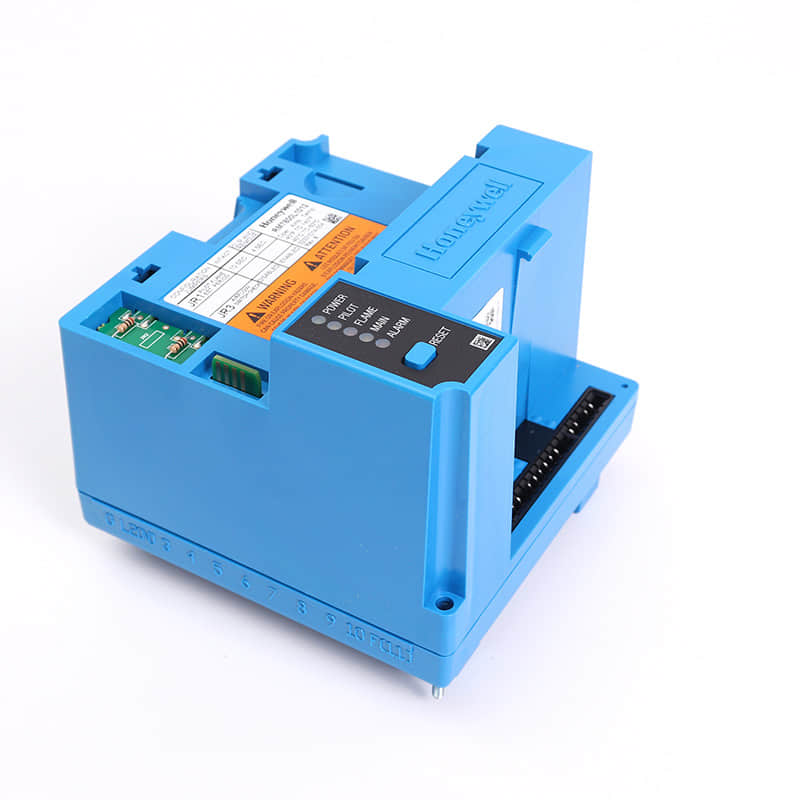
Controller Diagnostics: Check the LED codes on your Honeywell controller (for example, the RM7800 series). Confirm if the issue is a logic fault or signal loss.
Building a "Machine Health Profile"
Don't rely on memory; rely on data. Every time a "Flame Failure" alarm triggers, log these three points:
Time & Load: Note the exact time, the burner load (Low/High Fire), and the current boiler pressure or temperature.
Environmental Context: Was a large motor starting up? Was there welding nearby? Did the humidity or temperature shift suddenly?
Intervention: Did cleaning, tightening, or just a power cycle fix the issue?
Treat two identical faults in a row as a systemic risk. If the same issue keeps surfacing, compare your log with data from similar burners. You will often find design flaws or recurring operational mismatches.
In this industry, the biggest threat isn't a fault—it's an unknown fault. By using a checklist and logging data, you grow from a basic "repairman" into a "systems maintenance expert." You can then master combustion logic.
Final Thoughts
A "Flame Failure" alarm is rarely just about a bad part. As we covered, these issues often come from electrical noise, mechanical wear, unstable airflow, or material fatigue.
Most of the time, your equipment isn't "broken." It struggles to meet the demands of a harsh industrial environment. If you stop mindlessly swapping out components and start analyzing the system as a whole, you’ll stop chasing ghosts.
By switching from reactive repairs to preventive boiler maintenance, you can extend your boiler’s life. You can also prevent these “invisible killers.” However, if you face complex logic issues or need Industrial Combustion Controller Repair support, our team can help. Our experts will restore your system to peak performance.
Why Choose YMZDCS?
We provide high-precision industrial components from Honeywell, Siemens, Emerson, ABB, and Yokogawa.
Why partner with us?
Accuracy: We verify every specification to prevent costly procurement errors.
Reliability: We ensure authentic, high-quality sourcing for your critical systems.
Global Logistics: We handle complex documentation and safe delivery from Xiamen.
Proactive Service: We go beyond sales to support your operational success.
Professional sourcing, simplified.
For more, please refer to https://www.ymzdcs.com