1. Introduction: The Engineering Challenge of Selecting Siemens S7-1200 Models
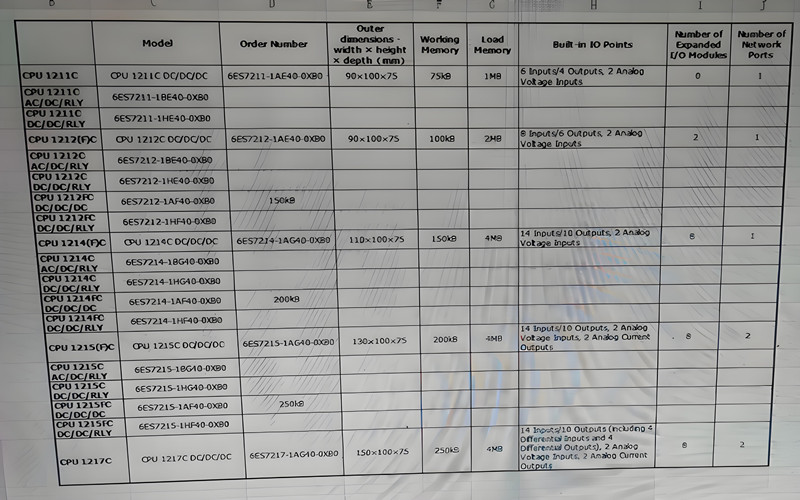
Selecting the appropriate model within the Siemens SIMATIC S7-1200 controller family can be a complex task for system integrators and engineers. Different part numbers within the same series vary significantly across critical technical parameters, including physical dimensions, work memory, load memory, integrated I/O points, expandable signal modules, network port counts, retention memory, communication module capacity, signal boards, processing execution speed, and supported motion control axes.
Navigating this dense matrix of specifications without practical field experience often leads to over-specification or operational bottlenecks. This engineering guide outlines a structured, parameter-driven methodology to simplify the selection process, balance cost-effectiveness, and ensure long-term system reliability.
2. Key Technical Parameters in S7-1200 Selection
When evaluating S7-1200 CPU variants (such as CPU 1211C, 1212C, 1214C, 1215C, and 1217C), engineers must focus on core hardware metrics rather than getting overwhelmed by every minor specification:
Integrated Memory: Comprises work memory (for executing user logic, data blocks, and symbol tables) and load memory (for storing the project program, firmware, and backup data).
I/O Point Density: The baseline number of digital and analog inputs/outputs integrated directly onto the base unit.
Expansion Scalability: The maximum number of Signal Modules (SM), Communication Modules (CM), and Signal Boards (SB) that the base CPU rack can support for future plant expansion.
Communication Interfaces: The number of onboard PROFINET/Ethernet ports and support for serial communication or fieldbus submodules.
Motion Control Capabilities: Integrated high-speed counters (HSC) and pulse train outputs (PTO) for controlling stepper drives and servo axes.
3. Practical Engineering Experience & Selection Scenarios
Based on field deployment experience, efficient PLC selection relies on identifying primary project constraints rather than evaluating every data sheet parameter:
Targeted Feature Matching (e.g., CPU 1217C): If your application specifically demands dual communication network ports and support for differential pulse input/output on the base unit for precise motion control, you can quickly narrow down the selection guide to high-performance models like the CPU 1217C.
Cost-Optimized Minimalist Selection (e.g., CPU 1211C): For compact, standalone machines requiring minimal hardware—such as four digital inputs, two digital outputs, a single network port, and no requirement for expandable I/O modules—the entry-level CPU 1211C delivers a cost-effective, space-saving solution.
Engineering Design Margins: Never size a PLC's I/O points or memory to exact limits. Always incorporate a 20% to 30% margin to accommodate future functional changes, software updates, or unexpected hardware channel failures on the factory floor.
Precise Part Number Documentation: Once the exact CPU model and variant are determined via the official Siemens selection guide, ensure the precise part number (MLFB) is recorded and verified to prevent procurement errors during purchasing.
4. Summary Matrix of S7-1200 CPU Variants
CPU Model | Base Integrated I/O | Signal Board (SB) Support | Communication Modules (CM) | Typical Application Scope |
CPU 1211C | 6DI / 4DO / 2AI | 1 | 1 | Small standalone machines, compact OEM equipment |
CPU 1212C | 8DI / 6DO / 2AI | 1 | 2 | Small-to-medium packaging or sorting lines |
CPU 1214C | 14DI / 10DO / 2AI | 1 | 2 | Standard modular machines, general factory automation |
CPU 1215C | 14DI / 10DO / 2AI + 2AO | 1 | 2 | Applications requiring integrated analog outputs & dual ports |
CPU 1217C | 14DI / 10DO / 2AI + 2AO (Differential) | 1 | 3 | High-performance motion control, multi-axis positioning |
Need assistance sourcing Siemens S7-1200 controllers, expansion modules, or specialized industrial automation hardware? Contact our engineering supply team today for professional cross-reference and procurement support.
For previous part, please refer to the link: Critical Considerations for PLC Selection
For a complete overview of all Siemens automation solutions, check out our master guide: