1. Overview
Choosing a PLC selection requires careful evaluation of technical, economic, regulatory, and operational factors. Proper selection ensures a stable, high-performance automated system while maximizing investment value. Understanding how to select a PLC, including electrical capacity, future scalability, and compatibility with SCADA systems, is essential for successful industrial control.
This guide covers how to choose a programmable logic controller (PLC). It includes criteria for selecting a PLC, stages for hardware selection, the PLC cycle, and other important factors. These will help you find the best PLC for your needs.
2. General Questions
2.1 Explain the factors to be considered for selection of PLC
When selecting, you should:
l Determine whether your system is new or existing
l Make sure you are using a current (or relatively new) platform
l Assess electrical capacity and what is the number and type of inputs/outputs needed
l Look for the platforms that offer redundancy
l Consider performance and capability, including processing speed, memory size, and response time
l Examine environmental conditions, reliability, compatibility, communication protocols, and expansion options
l Include safety certifications, energy efficiency, maintenance requirements, and overall cost
l Consider integration with field devices, assembly lines, and other process control systems
l Assess the growth stage of the automated system to ensure future scalability
2.2 What are the main parts of PLC / What are the parts of PLC
The main parts of a PLC include:
l Central Processing Unit (CPU) – executes the control program and manages logic
l Power supply – most PLCs do not come equipped with a power supply, so external sources may be required
l Input/output modules – include analog inputs and digital signals connecting sensors and actuators
l Communication modules – enable data exchange with SCADA systems, other PLCs, or field devices
l Memory and programming port – stores program and configuration
l Chassis or backplane – physical support for modules
These components work together to control industrial automation processes efficiently.
2.3 What are the stages of PLC / The PLC cycle
The stages of a PLC or PLC cycle include:
l Input signal processing from sensors and devices
l Program execution in the CPU
l Logic control operations using function block diagrams or ladder logic
l Output signal generation to actuators
l System monitoring and error diagnostics
This cycle ensures real-time, high-level automation and process control.
2.4 What are the 3 types of PLC
The three main types of programmable logic controllers PLCs are:
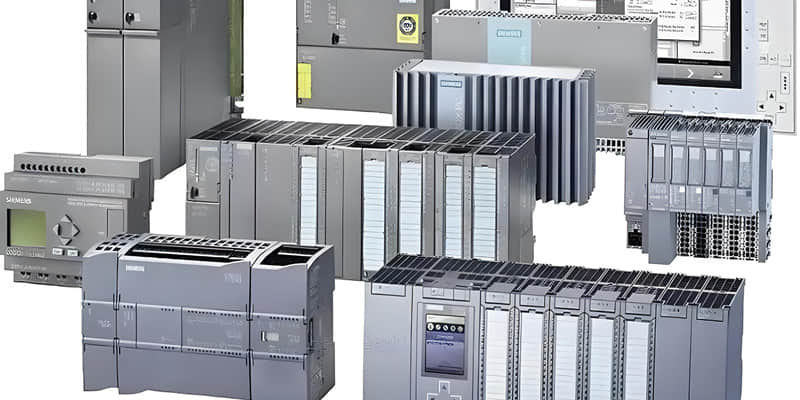
l Compact PLCs (fixed) – built-in I/O, ideal for small applications
l Modular PLCs – allow flexible expansion with separate CPU, I/O, and communication modules
l Rack-mounted PLCs – high-capacity systems for complex processes, large-scale industrial applications, and assembly lines
Using the right type saves time, improves reliability, and supports future system growth.
2.5 What is the PLC selection criteria / PLC selection
PLC selection criteria include:
A. Processing speed, electrical capacity, I/O capacity, and memory
B. Communication protocols and interface options
C. Environmental suitability and reliability
D. Compatibility with existing automated systems and operating systems
E. Programming flexibility, safety compliance, and maintenance requirements
F. Cost-effectiveness and scalability
The PLC selection process ensures the controller meets operational and expansion needs.
2.6 What is the purpose of the hardware selection stage in PLC development
The hardware selection stage identifies the suitable CPU, I/O modules, power supply, and communication modules. Its purpose is to ensure system performance and capability, compatibility, reliability, and scalability to meet industrial automation and process control requirements.
2.7 What are the 4 main components of a PLC
The four main components of a PLC are:
A. CPU – processes logic and executes control programs
B. Power supply – provides necessary energy to modules and peripherals
C. Input/output modules – interface with field devices via analog and digital signals
D. Programming device – writes, edits, and loads control programs
2.8 What is the selection series
The selection series is the systematic process of evaluating and choosing the PLC type, model, and configuration. Key factors include:
l Electrical capacity
l Processing speed, I/O capacity, and memory
l Reliability, redundancy, and modular PLCs options
l Communication protocols and SCADA systems compatibility
l Cost, scalability, and ability to integrate with automated system hardware
3. Considerations for Brand Selection
Familiar brands simplify installation, commissioning, and future maintenance. Ensure the PLC supports connectivity to local networks or SCADA systems if required. Popular brands include:
l Siemens PLCs: S7-1200, S7-1500, S7-400
l Mitsubishi and Omron: strong for motion control and cost-effective domestic solutions
6ES7521-1BL10-0AB0 Siemens SIMATIC S-1500 Module
Siemens 6FC5312-0DA00-0AA2 SINUMERIK Module
SIEMENS 6ES7441-2AA05-0AE0 SIMATIC S7-400 Digital Output Module
4. Analyze the Importance of Input/Output (I/O)
Estimating I/O Points
Count connected sensors and actuators, and add a 10–20% buffer for future expansion.
Compatibility Between PLC Model and Expansion Modules
Verify the selected PLC can handle required communication modules and analog inputs.
Signal Levels and Electrical Characteristics
Ensure the electrical signals match I/O modules, including voltage range, input impedance, and output current.
Response Time and Sampling Rate
Select I/O modules meeting real-time requirements. Include high-speed counters for fast assembly lines or repetitive operations.
I/O Module Installation and Wiring
Plan wiring for reliability, efficiency, and ease of integration with SCADA systems and field devices.
5. Selection of I/O Types
l Digital Input/Output (DI/DO)
l Analog Input/Output (AI/AO)
l Relay vs. transistor outputs depending on process control needs
6. Selection of Communication Protocols
Ensure PLC communication protocols are compatible with expansion modules and central units. Standard protocols include Modbus, Profibus, and Ethernet/IP.
7. Power Supply Configuration
l Transistor-type PLCs: typically use 24V DC
l Relay-type PLCs: select a power supply rated 30% above requirement
l Most PLCs do not come equipped with a power supply; external sources may be needed
8. I/O Capacity Calculation
Include both digital and analog signals. For analog, consider 0–10 V or 4–20 mA devices. Example: Siemens S7-200 Smart PLC with MAM 06 analog module. Proper I/O selection ensures seamless integration with SCADA systems, field devices, and assembly lines, saving time during deployment.
Some brand PLC, for your reference:
Exploring Allen Bradley 1763 Logic 1000 Controller 1763-l16dwd
Allen-Bradley 1756-IF16 Analog Input Module
Woodward 8800-1001 Two Channels DSS-2 Speed Control