1. Introduction: Strategic Guidelines for Selecting an Industrial PLC
Choosing the right Programmable Logic Controller (PLC) requires a systematic evaluation of technical, economic, regulatory, and operational factors. Proper hardware selection ensures a stable, high-performance automated system while maximizing long-term investment value.
Navigating how to select a PLC involves analyzing electrical capacity, processing speed, future scalability, environmental constraints, and seamless compatibility with SCADA and industrial network architectures. This comprehensive engineering guide covers essential evaluation criteria, hardware configuration stages, I/O sizing strategies, and brand ecosystems to help system integrators and procurement specialists identify the optimal controller for their specific application.
2. Core Selection Criteria and Engineering Factors
Engineers must evaluate a comprehensive matrix of parameters when specifying a PLC for a new installation or a legacy retrofit:
System Architecture Status: Determine whether the project involves a greenfield installation or a brownfield integration with existing legacy infrastructure. Ensure you specify a current, actively supported hardware platform to prevent early obsolescence.
Electrical and I/O Capacity: Accurately count connected sensors and actuators, then incorporate a 20% to 30% safety buffer for future plant expansions.
Performance and Execution Speed: Assess CPU processing speed, internal memory size, and scan cycle response time, especially for high-speed motion control or rapid sorting applications.
Environmental and Ruggedization Ratings: Evaluate operating temperatures, vibration thresholds, humidity, and electrical noise immunity (EMI) on the factory floor.
Redundancy and Reliability: For critical continuous process control loops (e.g., chemical plants or power generation), specify platforms offering CPU and power supply redundancy to eliminate single points of failure.
Safety Certifications and Compliance: Ensure the hardware complies with relevant industrial safety standards (e.g., SIL ratings, CE, UL) and energy efficiency requirements.
3. PLC Hardware Architecture and Component Selection
A robust industrial control panel relies on the careful selection of modular hardware components:
Central Processing Unit (CPU): The primary logic solver that executes user programs, manages data blocks, and coordinates communication.
Power Supply Unit (PSU): Converts AC mains power into stable DC rails. While compact micro-PLCs often integrate power supplies, modular rack systems require dedicated external supplies (typically sized 30% above maximum load for relay-type setups or standardized at 24VDC for transistor outputs).
Input/Output (I/O) Modules: Physical interfaces handling digital signals (ON/OFF switches, pushbuttons) and analog process values (4-20mA transmitters, 0-10V sensors, thermocouples).
Communication Modules: Enable high-speed data exchange via industrial protocols like PROFINET, EtherNet/IP, and Modbus TCP.
Chassis and Backplane: Provides secure mechanical support and high-speed internal data buses for modular expansion cards.
some similar items, for your reference:
6ES7521-1BL10-0AB0 Siemens SIMATIC S-1500 Module
Siemens 6FC5312-0DA00-0AA2 SINUMERIK Module
SIEMENS 6ES7441-2AA05-0AE0 SIMATIC S7-400 Digital Output Module
4. Main PLC Types and Architectural Scaling
Selecting the correct physical architecture depends on the scale and complexity of the automated machinery:
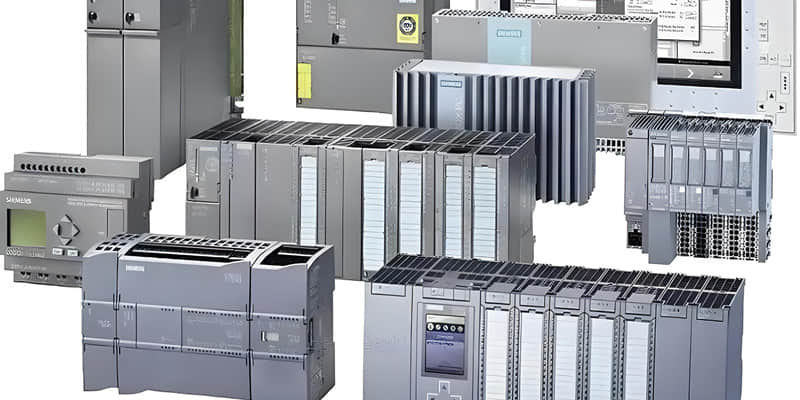
Compact (Fixed) PLCs: Integrate the CPU, power supply, and a fixed number of I/O points into a single enclosure. Ideal for cost-sensitive, standalone machines and small-scale automation cells.
Modular PLCs: Built on a rack or backplane using interchangeable, standalone modules. This architecture offers superior scalability, flexible I/O expansion, and easy maintenance for mid-to-large industrial applications.
Rack-Mounted / High-Capacity PLCs: High-performance systems designed for complex, plant-wide industrial networks, multi-axis motion control, and high-speed assembly lines.
5. Major Global PLC Brands and Hardware Ecosystems
Standardizing on established manufacturing ecosystems simplifies installation, commissioning, software training, and long-term spare parts procurement:
Siemens (SIMATIC S7-1200 / S7-1500 / S7-400 Series): Industry leader in process automation and factory floors, offering high processing efficiency, robust TIA Portal software integration, and advanced communication standards.
Reference Hardware: Siemens SIMATIC S7-1500 Module (
6ES7521-1BL10-0AB0), SINUMERIK Module (6FC5312-0DA00-0AA2), and SIMATIC S7-400 Digital Output Module (6ES7441-2AA05-0AE0).Rockwell Automation / Allen-Bradley: Exceptional durability and scalable architecture heavily adopted in North American manufacturing ecosystems.
Mitsubishi Electric & Omron: Highly competitive in Asian and global machinery markets, renowned for compact footprints, cost-effective domestic solutions, and specialized motion control performance.
6. Practical Best Practices for I/O Sizing and Network Integration
I/O Signal Matching: Verify that electrical signal characteristics—such as voltage ranges, input impedance, and output current—strictly match your field instrumentation. Choose between relay outputs (higher current capacity, lower switching speed) and transistor outputs (fast switching, solid-state reliability for high-frequency operations).
Communication Protocol Interoperability: Ensure native or modular support for standard plant networks, such as Modbus RTU/TCP for serial/Ethernet polling, Profibus-DP/PROFINET for European machinery, or EtherNet/IP for North American systems.
Need assistance sourcing rare or obsolete automation hardware, PLC modules, or industrial control components? Contact our engineering supply team today for professional cross-reference and procurement support.
Some brand PLC, for your reference:
Exploring Allen Bradley 1763 Logic 1000 Controller 1763-l16dwd
Allen-Bradley 1756-IF16 Analog Input Module
Woodward 8800-1001 Two Channels DSS-2 Speed Control